


I. Introduction
II. Methods
2.1. Synthetic cancellous-bone models
2.2. Elastic-wave simulation
2.3. Ultrasonic transmission and RF acquisition
2.4. PS and PI attenuation analysis
2.5. Statistical analysis
III. Results
IV. Discussion
V. Conclusions
I. Introduction
Quantitative Ultrasound (QUS) provides a non-ionizing method for bone assessment and has been applied particularly to peripheral skeletal sites containing a large proportion of cancellous bone. Broadband Ultrasound Attenuation (BUA), together with speed of sound, is a principal calcaneal QUS parameter reflecting interactions with the heterogeneous bone-marrow structure.[1] In human calcaneus, attenuation is associated with bone quantity, including bone mineral density and Bone Volume fraction (BV/TV), while microarchitecture may provide additional information on ultrasonic propagation.[2]
Attenuation estimated over a finite receiving aperture also depends on signal combination. Phase-Sensitive (PS) processing coherently averages complex receiver signals while retaining relative phase, allowing propagation differences to produce constructive or destructive interference. Phase-Insensitive (PI) processing instead averages spectral power across receivers, so relative phase among receivers does not contribute to aperture averaging.[3] Previous studies have consistently reported greater attenuation with PS than PI processing.[4,5,6] For instance, Cheng et al.[6] found higher PS than PI-normalized Broadband Ultrasound Attenuation (nBUA) in trabecular-bone specimens. However, because bone quantity and three-dimensional architecture vary simultaneously in biological specimens, whether variability remains among structures with similar BV/TV is unclear.
In this study, PS and PI attenuation were investigated in 120 three-dimensional synthetic cancellous-bone models comprising 30 BV/TV strata with four independently generated morphologies per stratum. This controlled design allowed attenuation variability to be examined among structures with similar bone quantity under identical material and measurement conditions. PS- and PI-nBUA were compared in terms of magnitude, frequency dependence, association with BV/TV, and within-stratum variability. In addition, associations between BV/TV- adjusted attenuation residuals and predefined structural descriptors were evaluated.
II. Methods
2.1. Synthetic cancellous-bone models
A total of 120 three-dimensional synthetic cancellous- bone models were selected a priori from a master ensemble of 300 models using a predefined cyclic selection across 30 BV/TV strata, with four independently generated morphologies per stratum. The models covered a binary BV/TV range of 0.0831 to 0.1486 [mean ± Standard Deviation (SD), 0.1165 ± 0.0194], within the range of 0.019 to 0.151 reported for human cancellous calcaneus specimens.[2] The selection scheme was fixed before RadioFrequency (RF) or attenuation outcomes were examined.
Each 12 × 12 × 15 mm3 model was generated on an isotropic 30-µm grid (400 × 400 × 500 voxels) from an anisotropic Gaussian random field with prescribed correlation scales along the three anatomical axes. For wave simulation, the morphology was averaged over nonoverlapping 5 × 5 × 5 voxel blocks to a 150-µm grid (80 × 80 × 100), followed by rank-preserving binarization to preserve BV/TV. Morphology was characterized by bone- and void-chord proxies along the three axes and chord-based anisotropy. These measures were used only as structural descriptors and were not interpreted as conventional measures of trabecular thickness or separation.
2.2. Elastic-wave simulation
Three-dimensional elastic-wave propagation was simulated in the time domain using Devito (version 4.8.22).[7] A fourth-order spatial finite-difference scheme was used with a time step of 0.005 µs. Each bone model was placed in an 18 × 18 × 36 mm3 physical domain with an isotropic grid spacing of 0.15 mm. Ultrasound propagated along the 15-mm-long mediolateral (+z) direction. A 40-grid-cell (6-mm) damping layer was added around the physical domain to suppress boundary reflections, resulting in a computational domain of 30 × 30 × 48 mm3.
Bone was assigned a density of 1,850 kg/m3 and longitudinal and shear velocities of 3,260 m/s and 1,644 m/s, respectively; the corresponding marrow values were 1,055 kg/m3 and 1,479 m/s for density and longitudinal velocity.[8] These properties were fixed across all models. Intrinsic absorption was not included; therefore, the reported attenuation represents apparent attenuation arising from heterogeneous bone-marrow interactions rather than intrinsic material absorption.
2.3. Ultrasonic transmission and RF acquisition
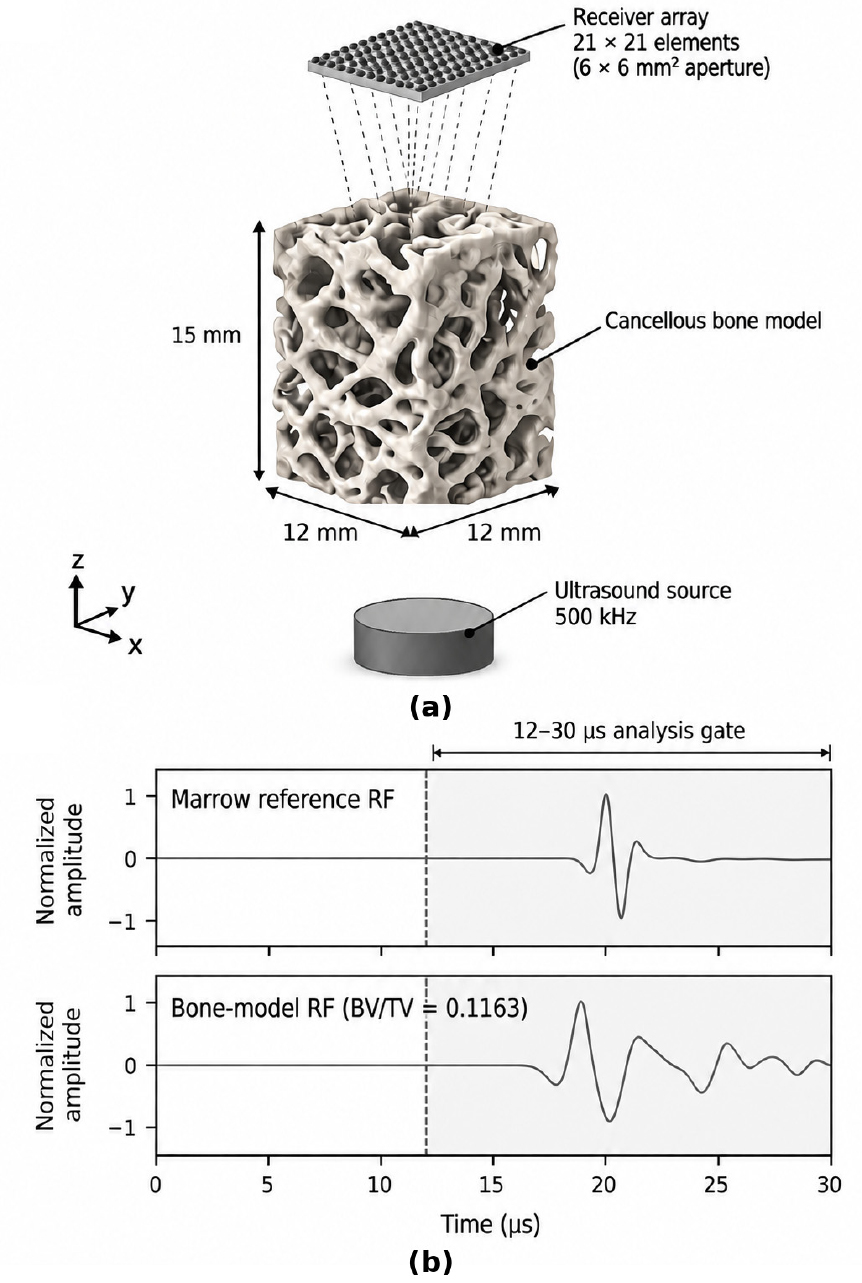
A broadband source centered at 500 kHz was positioned at z = 3 mm, and transmitted signals were recorded at z = 30 mm using a 21 × 21 receiver array (441 receivers) covering a 6 × 6 mm2 aperture with 0.30-mm spacing. RF signals were recorded for 30 µs at a sampling interval of 0.005 µs. A homogeneous marrow simulation under identical numerical and measurement conditions served as the reference. The simulation geometry and representative coherently averaged RF signals are shown in Fig. 1.
2.4. PS and PI attenuation analysis
Each RF record was gated from 12 µs to 30 µs with a 1-µs cosine taper at each end [Fig. 1(b)]. After gating, the full 6001-sample record was used for the Fourier transform, with no receiver-dependent time alignment or delay correction. For PS analysis, the complex spectra from the N = 441 receivers were coherently averaged, so inter-receiver phase differences could reduce the PS spectral amplitude through destructive interference, as follows:
where Xj(f) is the complex spectrum of the RF signal at receiver j. The corresponding PS spectral amplitude was defined as APS(f) = |XPS(f)|. For PI analysis, spectral power was calculated at each receiver and then averaged over the receiver aperture:
PS and PI attenuation relative to the homogeneous marrow reference were then calculated as 20/L log10 (APS,ref/APS,spec) and 10/L log10(PPI,ref/PPI,spec), respectively, where L = 1.5 cm and the subscripts ref and spec denote the homogeneous marrow reference and cancellous-bone model, respectively.
Ordinary least-squares lines were fitted over the prespecified clinically relevant band of 300 kHz to 700 kHz,[4,5] and their slopes were defined as PS-nBUA and PI-nBUA in dB/cm/MHz. ΔnBUA was defined as PS-nBUA – PI-nBUA. Because receiver powers are averaged rather than complex spectra, relative phase among receivers does not contribute to PI aperture averaging. PI attenuation still includes scattering and other propagation effects and was not interpreted as intrinsic material attenuation.
2.5. Statistical analysis
PS- and PI-nBUA were compared using a paired t test, with the mean paired difference and 95 % confidence interval reported. The relationship between PS- and PI-nBUA was evaluated by Pearson correlation and linear regression. Agreement was assessed by Bland-Altman analysis with 95 % limits of agreement and a test for proportional bias. Associations of PS-nBUA, PI-nBUA, and ΔnBUA with BV/TV were assessed by Pearson correlation and linear regression, and the PS-BV/TV and PI-BV/TV correlations were compared using Williams’s test for dependent overlapping correlations.[9]
Within-stratum SDs of PS- and PI-nBUA were calculated for each of the 30 BV/TV strata and compared using a paired t test. As a secondary analysis, BV/TV-adjusted attenuation residuals were correlated with six directional chord proxies and chord-based anisotropy. The resulting 21 tests were corrected for multiple comparisons using the Benjamini-Hochberg false-discovery-rate procedure. Spectral linearity from 300 kHz to 700 kHz was quantified by R2 and compared between PS and PI using a paired t test. Wilcoxon signed-rank tests were used as sensitivity analyses for paired comparisons. All tests were two-sided, with p < 0.05 considered statistically significant.
III. Results
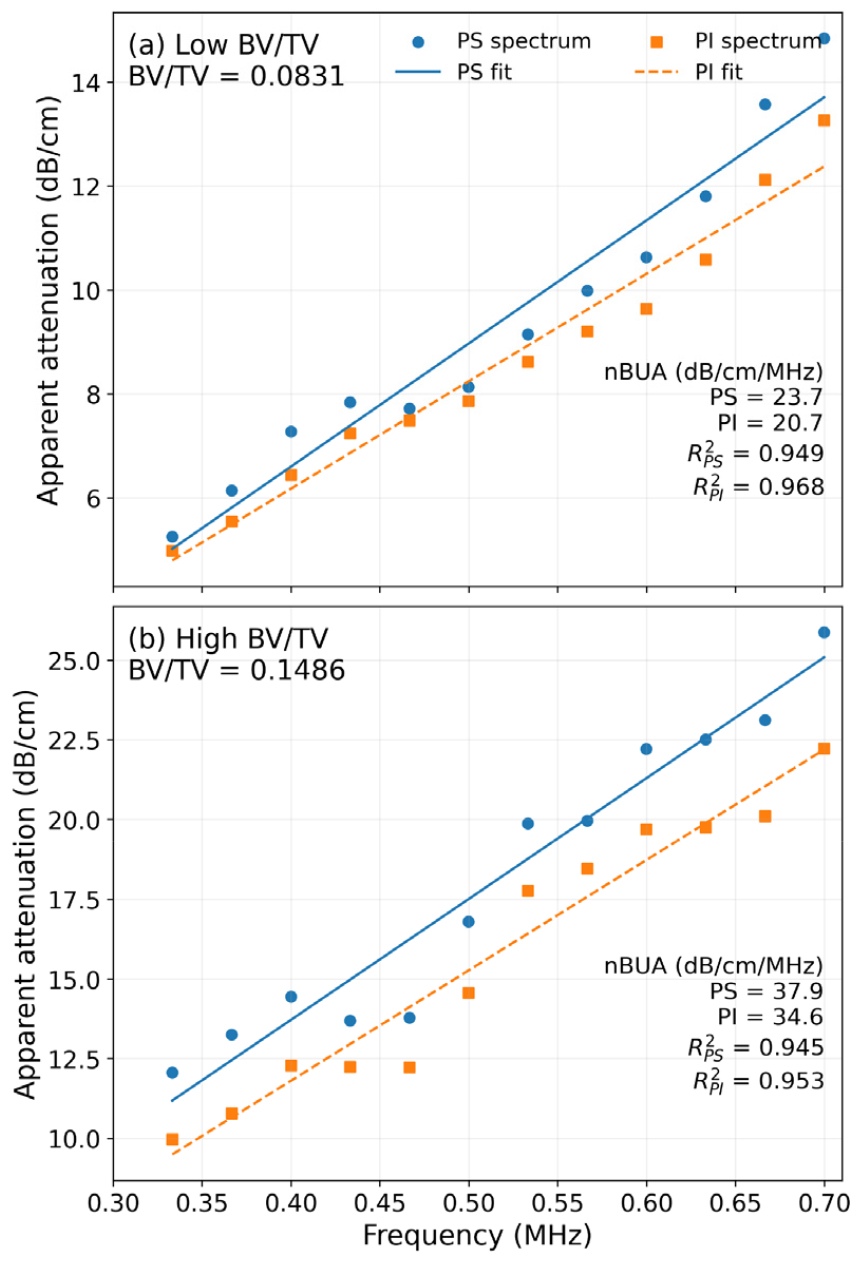
Representative PS and PI attenuation spectra from models at the lower and upper ends of the BV/TV range are shown in Fig. 2. Attenuation increased approximately linearly with frequency for both methods, with greater deviations from linearity for PS than PI. Across all models, mean R2 was 0.905 ± 0.067 for PS attenuation and 0.951 ± 0.023 for PI attenuation (p < 0.001).
PS-nBUA was significantly higher than PI-nBUA (mean ± SD, 39.04 ± 9.84 versus 30.55 ± 4.91 dB/cm/MHz), with a mean paired difference of 8.49 ± 6.60 dB/cm/MHz (95 % CI, 7.30 ~ 9.69 dB/cm/MHz; p < 0.001). The two measures were correlated [r = 0.801, p < 0.001; Fig. 3(a)]. Bland-Altman analysis yielded 95 % limits of agreement of –4.43 ~ 21.42 dB/cm/MHz, with significant proportional bias [p < 0.001; Fig. 3(b)].
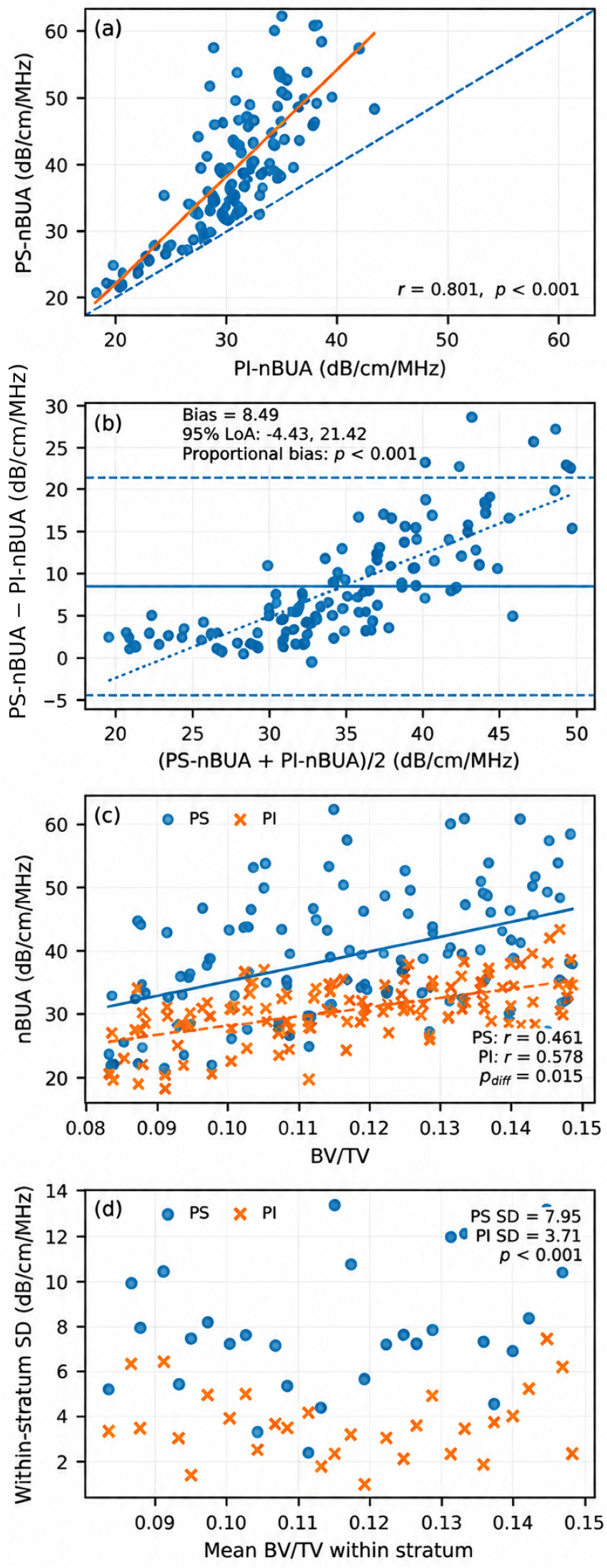
Fig. 3.
(Color available online) (a) Relationship between PS- and PI-nBUA with the simple linear regression line, (b) Bland-Altman analysis of the per-model difference (PS-nBUA - PI-nBUA) versus the corresponding mean [(PS-nBUA + PI-nBUA)/2], (c) relationships of PS- and PI-nBUA with BV/TV, and (d) within-stratum variability across the 30 BV/TV strata.
Both PS- and PI-nBUA increased with BV/TV [Fig. 3(c)]. The correlations were r = 0.461 for PS-nBUA and r = 0.578 for PI-nBUA (p < 0.001 for both), with a significantly stronger correlation for PI-nBUA (p = 0.015). ΔnBUA was correlated with BV/TV (r = 0.257, p = 0.0045).
Across the 30 BV/TV strata, the mean within-stratum SD was 7.95 dB/cm/MHz for PS-nBUA and 3.71 dB/cm/MHz for PI-nBUA [Fig. 3(d); p < 0.001]. After linear adjustment for BV/TV, the residual variances were 76.26 and 16.03 (dB/cm/MHz)2 for PS- and PI-nBUA, respectively. None of the seven predefined structural descriptors was significantly associated with residual PS-nBUA, PI-nBUA, or ΔnBUA after adjustment for BV/TV and correction for multiple comparisons.
IV. Discussion
PS-nBUA was significantly higher than PI-nBUA, although the two measures were strongly correlated. Higher PS than PI attenuation has also been reported in previous experimental studies of cancellous bone.[4,5,6] The magnitude of the PS-PI difference cannot be directly compared among studies because of differences in specimen type, measurement geometry, frequency range, and attenuation definition.
A principal result of the present study was the greater variability of PS-nBUA among models with similar bone quantity. Across the 30 BV/TV strata, the mean within- stratum SD was 7.95 dB/cm/MHz for PS-nBUA and 3.71 dB/cm/MHz for PI-nBUA; after adjustment for BV/TV, the residual variances were 76.26 and 16.03 (dB/cm/ MHz)2, respectively. Thus, the difference in variability was present both within BV/TV strata and after adjustment for BV/TV. Propagation through the heterogeneous bone-marrow structure can produce phase differences among receiver signals, and coherent averaging can introduce inter-receiver phase cancellation. This phase cancellation may contribute to the greater variability of PS-nBUA, although it was not quantified independently. PI processing reduces this contribution during aperture averaging but does not remove scattering or interference within individual propagation paths.
PI-nBUA was more strongly correlated with BV/TV than PS-nBUA (r = 0.578 versus 0.461). PI attenuation was also more linear with frequency. ΔnBUA was only weakly correlated with BV/TV (r = 0.257), suggesting that bone quantity alone does not account for the PS-PI difference.
None of the seven predefined chord-based structural descriptors was significantly associated with attenuation residuals after adjustment for BV/TV and correction for multiple comparisons. This does not exclude an effect of three-dimensional architecture, because the descriptors used here may not capture structural features related to phase differences across the receiver aperture.
The synthetic models do not fully represent human cancellous-bone microarchitecture. Fixed material properties and the absence of intrinsic absorption allowed PS and PI processing to be compared under identical conditions but limit extrapolation to biological measurements. Phase cancellation was inferred from the difference between PS and PI processing rather than quantified independently. Experimental validation in human calcaneus and evaluation across different measurement geometries are needed to assess the generalizability of these results to clinical QUS.
V. Conclusions
Phase-sensitive processing produced higher nBUA and greater variability than phase-insensitive processing in three-dimensional synthetic cancellous-bone models. PI-nBUA was more strongly associated with BV/TV and was more linear with frequency from 300 kHz to 700 kHz. The greater variability of PS-nBUA persisted within BV/TV strata and after adjustment for BV/TV, and inter-receiver phase cancellation during coherent aperture averaging may contribute to this variability. PI processing reduces inter-receiver phase cancellation during aperture averaging but does not represent intrinsic material attenuation.