


I. Introduction
II. Conventional Narrowband ANC Systems
2.1 Narrowband ANC Model
2.2 Convergence speed comparison
III. New Narrowband ANC System
3.1 Parallel form FxGAL Algorithm
3.2 Convergence Analysis
IV. Simulation Results
V. Conclusions
I. Introduction
Active noise control (ANC)[1-3] is based on the principle of superposition, where an unwanted primary noise is canceled by a secondary noise of equal amplitude and opposite phase. The primary noise produced by rotating machines, such as engines, is periodic and contains multiple harmonic-related narrowband components. In such applica-tions, a nonacoustic sensor such as a tachometer or an accelerometer[3] is often used to synchronize an internally generated reference signal, and thus the feedback from the secondary source to the reference sensor can be prevented. The vast number of narrowband ANC algorithms have been proposed, which can be found from the previous publications[1-13] and references therein.
In practical narrowband ANC applications, e.g. electronic mufflers on automobiles, periodic noise usually contains multiple sinusoids at the fundamental and several dominant harmonic frequencies. Based on this observation, Glover[4] used a sum of cosine or sine waves as a reference signal of an adaptive filter with order much higher than two. However, the order of the adaptive filter required to achieve the same convergence speed increases as the frequency separation between two adjacent sinusoids in the reference signal decreases or the fundamental frequency moves to  or
or  .[5,6]
To overcome this problem, Kuo et al.[6] proposed a direct/parallel form method based on the filtered-x least mean square (FxLMS) algorithm. The idea is to separate a collection of many harmonically related sinusoids into mutually exclusive sets that individually have fre-quencies spaced out as far as possible. However, the direct/parallel form method doesn’t completely eliminate the effect of the frequency separation and fundamental frequency on the convergence speed.[6]
One possible solution to the dependency on the fun-damental frequency and frequency separation is to use adaptive  filters connected in parallel, each of which is excited by a single-frequency sinusoid.[7] Using cosine and sine waves as reference signals, the parallel form method has a convergence speed independent on the fundamental frequency and frequency separation.[3] However, to imple-ment the FxLMS algorithm in the parallel form, two estimated secondary-path filters are required for each reference channel. Normally, the secondary paths are modeled using finite impulse response (FIR)-type filters, which pose a computational complexity and result in a bottleneck in system implementation.[8]
To solve the complexity issue of the parallel form method, a simplified approach proposed in,[9] where simplified single-frequency ANCs are connected in parallel and the sine wave generator is replaced with a simple delay. In the simplified parallel form method, a single secondary-path filter is required for each reference channel, which is the half of the parallel form method.
However, in this paper, it is shown that the convergence speed of the simplified parallel form method in[9] becomes slower as the fundamental frequency moves to  or
or  . Since the fundamental frequency in practical applications can be very low, the simplified parallel form method is likely to suffer from slow convergence speed.
In this paper, a new simplified parallel form method based on the filtered-x gradient adaptive lattice (FxGAL) algorithm is proposed. In the proposed algorithm the  th reference signal vector is orthogonalized using four additional coefficients per channel. As a result, the eigenvalue spread of the
  th reference signal correlation matrix always becomes 1. Thus, the convergence speed of the proposed method is independent on the frequency of reference sinusoids and its computational complexity is similar to the simplified parallel form method.[3]
The rest of this paper is organized as follows. Section II starts with analyzing conventional narrowband ANC system. The proposed narrowband ANC system is presented in Section III. Section IV comprises the experimental results comparing the proposed narrowband ANC system with conventional narrowband ANC system. Finally, conclusions of this work are drawn in Section V.
II. Conventional Narrowband ANC Systems
2.1 Narrowband ANC Model
Fig. 1 depicts the block diagram of the direct form narrowband ANC system based on the FxLMS algorithm. The primary noise  comprises
  dominant narrow-band components at frequency
  . The primary noise also contains a zero-mean additive white Gaussian noise
  with variance
  . The transfer func-tions
  and
and  represent the primary and secondary paths, respectively.
  is the secondary path estimate (or model). Synchronization signal triggers the sinewave generator that produces the reference signal, which is filtered by the adaptive FIR filter
  to produce the anti-noise
  to cancel the primary noise
  . The canceling signal
  is generated as
 , (1)
, (1)
where  denotes transpose operation,
 is the weight vector of the adaptive filter
  , and
, and  is the reference signal vector. The adaptive filter length
  should be at least twice the total number of sinusoids to deal with both the in-phase and the quadrature components, i.e.,
  .
.
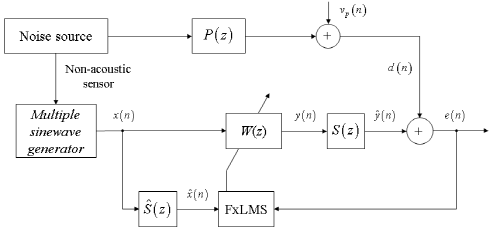
The error signal is expressed as
 , (2)
, (2)
where  is the secondary path filter.
Assuming that the estimated secondary path model  is an FIR filter with length
  :
:
 . (3)
. (3)
The filtered reference signals are computed as[3]
 ,z (4)
where  are the coefficients of
  .
.
The weight vector is updated using the FxLMS algorithm[3]
 , (5)
, (5)
where  is the step-size parameter.
2.2 Convergence speed comparison
For a stationary input and sufficiently small step-size parameter  , the convergence time
  is dependent on the eigenvalue spread
  of the autocorrelation matrix as[14]
 , (6)
, (6)
where  is the sampling period. Small eigenvalue spread can be obtained by reorganizing the filtered reference signal vector. Thereby, a number of different narrowband ANC systems have been developed.[1,3,5,7]
For the simplification of analysis, the reference sinusoids are expressed as[6]
 , (7)
, (7)
where  is the fundamental frequency,
  is the frequency separation, and
  is the phase of the estimated secondary path. The amplitude of the estimated secondary path
  are assumed to be unity.
In the direct form method,[6] a close-form expression of eigenvalues is difficult to obtain when the total number of sinusoids is greater than two. Previously in,[6] bounds for the extreme eigenvalues were used to analyze the eigenvalue spread of the direct form. The lower bound for eigenvalue spread can be expressed as
 , (8)
, (8)
where 
 . According to the analysis, the eigenvalue spread of the direct form method is significantly affected by the fundamental frequency and frequency separation.[6]
However, in the parallel form method, using cosine and sine wave as the  th channel reference signal, the eigenvalue spread of the parallel form method is 1.[3]
In the simplified parallel form, only cosine or sine waves is used as the reference signal, so that the eigenvalue can be expressed as[3]
|
Fig. 2. Effect of frequency separation |
|
Fig. 3. Effect of fundamental frequency |
 on eigenvalue spread (
 = 4,
= 4,  = 8,
= 8,  ).
).
 on eigenvalue spread (
 = 4,
= 4,  = 8,
= 8,  ).
). . (9)
. (9)
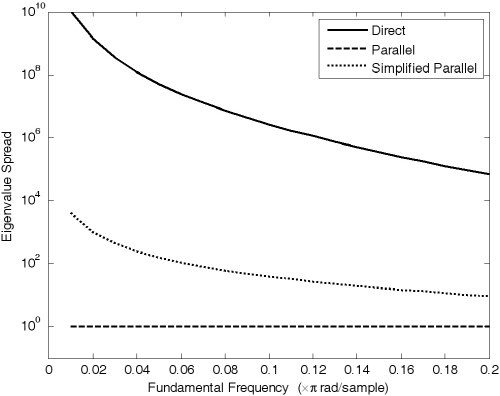
Fig. 2 shows the eigenvalue spread versus different fundamental frequencies for  ,
,  . The frequency separation is
  . Fig. 2 clearly shows that the fundamental frequency affects the eigenvalue spreads of the direct and simplified parallel form methods, but does not affect that of the parallel form method.[3,6] Especially, this figure shows eigenvalue spreads of the direct and simplified parallel form methods significantly increase as the fundamental frequency decreases, which is problematic because the primary noise in practical situation can have very low fundamental frequencies.
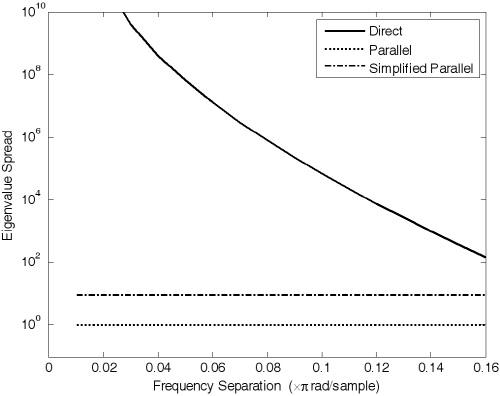
Fig. 3 shows the eigenvalue spread versus different frequency separations for  ,
,  . The fundamental frequency is
  . Fig. 3 clearly shows that the frequency separation affects the eigenvalue spreads of the direct form method, but does not affect those of the parallel and simplified parallel form methods.[3,6]
Figs. 2 and 3 show that the parallel form method is independent on the frequency of the reference signal. However, the parallel form method based on the FxLMS algorithm requires  multiplications for secondary path filtering. In practical situations, the length of secondary path model should be long, so that the secondary path filtering becomes burden. In the simplified parallel form method, the sine wave generator is replaced with simple time delay, which saves the
  multiplications.[3] However, its eigenvalue spread depends on the fundamental frequency.
III. New Narrowband ANC System
3.1 Parallel form FxGAL Algorithm
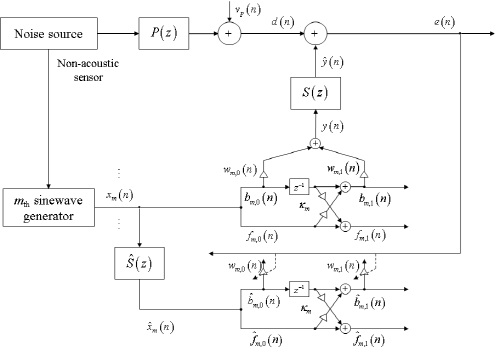
In this paper, we propose a new narrowband ANC system. In an effort to reduce the eigenvalue spread ratio and thus to improve the convergence speed, the filtered-x gradient adaptive lattice (FxGAL) algorithm[15,16] is applied to each two-weight adaptive filter of the simplified parallel form method.
Consider a second-order lattice predictor that transforms the  th channel filtered reference signal into the orthogonal filtered backward prediction error.This orthogonalization is carried out in the lattice through formulas[15,16]:
 , (10)
 , (11)
where  is the th channel reflection coefficient and
  . The
. The  th channel filtered backward prediction errors are orthogonal to each other as
 . (12)
Assuming the filtered reference signal  is the pseudorandom noise signal,[17] the
  th channel reflection coefficient can be expressed as
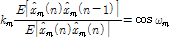 . (13)
Using the FxGAL algorithm,[13,14] the update equation for the th channel regression coefficient  can be expressed as
 , (14)
 , (15)
where  is the th channel regression coefficients vector,
  and
and  are the
  th channel backward prediction errors vector and
  th channel filtered backward prediction errors vector, respectively. The matrix
  is a diagonal matrix with diagonal elements given by the power of the
  th filtered backward prediction error
  . The power of
  th filtered backward prediction error can be recursively estimated using the single-pole low-pass filter as
 , (16)
where  is the smoothing factor.
Finally, the proposed parallel FxGAL-based narrowband ANC system is shown in Fig. 4.
3.2 Convergence Analysis
For ease of analysis, the cosine wave  is treated as a pseudorandom noise signal which leads to simple derivations and elegant equations without sacrificing the accuracy of the analysis.[17] We also assume that
  or the secondary path has been very closely modeled. An optimum weight vector
  can be obtained by minimizing the mean square error (MSE)[18]
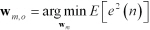 .
.We first rewrite the update equation in (13) using the eight error vector, defined as  [18]:
[18]:


where  and
and  is the identity matrix. Using (11) and taking the expected value of (17), we obtain
 . (19)
Significance of (18) is that the convergence speed of the parallel FxGAL algorithm is independent of the eigenvalue spread, and it only depends on the step-size parameter  . Hence, the proposed parallel FxGAL-based narrowband ANC system has a convergence speed independent on the reference frequency and/or frequency separation. But the proposed FxGAL-based narrowband ANC system requires only one secondary path filtering in each reference channel.
In summary, the proposed FxGAL-based narrowband ANC system has similar convergence speed to that of the parallel form method, but the proposed FxGAL-based narrowband ANC system has similar computational complexity to that of simplified parallel form method.
IV. Simulation Results
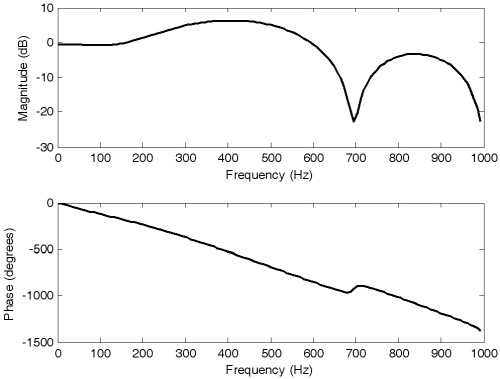
Computer simulations were conducted to evaluate the performance of the proposed FxGAL-based narrowband ANC system. The sampling rate was 2 kHz. The primary path  shown in Fig. 5 was used. To analyze the effect of the fundamental frequency and frequency separation, the secondary path was assumed to be
  . The number of sinusoids was
  , and the length of the adaptive filter was
  . A white Gaussian noise
  was added at 20 dB SNR. The results shown below were ensemble averaged over 100 trials.
|
Fig. 5. Magnitude (top) and phase (bottom) responses of primary path |
|
(a) |
|
(b) |
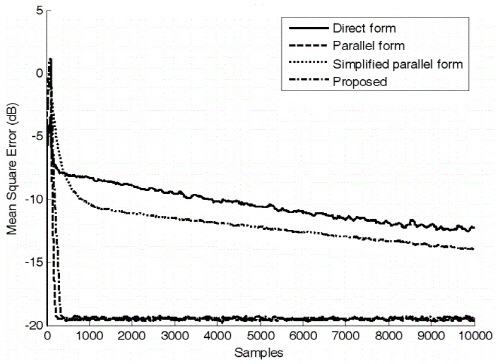
Fig. 6. MSE of narrowband ANC systems for (a) |
 .
.
 Hz and (b)
  Hz, and
  Hz.
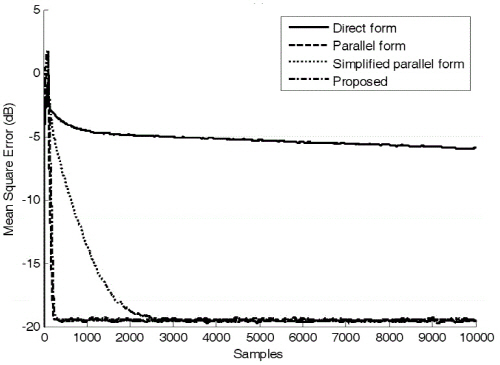
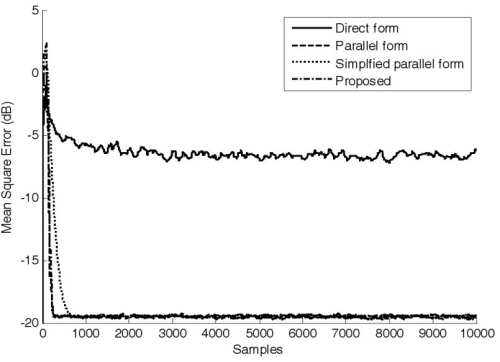
Hz.Fig. 6 compares the convergence behavior of narrowband ANC systems for low-fundamental frequency. The fun-damental frequency was  Hz [6(a)] and 100 Hz [6(b)], and frequency separation was
  Hz. Step-size parameters were experimentally selected to equalize the steady-state MSEs of each narrowband ANC system:
  for the direct form, parallel form, and simplified parallel form methods, and
  for proposed mthod. Results show that the convergence speeds of the direct form and simplified parallel form methods vary according to the fundamental frequency. However, the parallel form and the proposed methods show robustly similar convergence speed for all test cases.
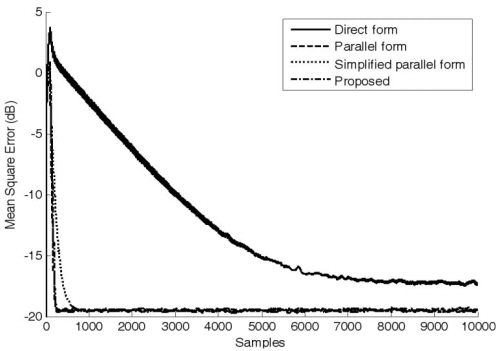
Fig. 7 compares the convergence behavior of narrowband ANC systems according to the frequency separation. The fundamental frequency was  Hz and frequency separations of
  Hz and 50 Hz were tested. Step-size parameters were experimentally selected to equalize the steady-state MSEs of each narrowband ANC system:
  for the direct, parallel, and simplified parallel form methods, and
  for the proposed method. It can be seen that the parallel form, simplified parallel form, and proposed methods have the same convergence speed regardless of the frequency separation.
 Hz, and (a)
  Hz and (b)
  Hz.
Hz.V. Conclusions
In this paper, a new simplified parallel form narrowband ANC system based on the FxGAL algorithm has been proposed. Like the parallel form narrowband ANC system, the proposed narrowband ANC system has a convergence speed that is independent of both the fundamental frequency and frequency separation, but it requires significantly lower computational complexity than the parallel form narrowband ANC system. However, if the nonacoustic reference sensor is not available, then the proposed narrowband ANC system cannot be utilized.