


I. Introduction
II. Filtration system with ultrasonic atomizer and cyclones
III. Results and discussion
IV. Conclusions
I. Introduction
In practical applications of nanoparticles, dispersion of the agglomerated nanoparticles with physical or chemical causes is one essential process.[1] Many studies have used chemical and physical methods for dispersing agglomerates of nanoparticles.[2,3,4,5,6] However, even after a dispersion processing, the particle size is distributed widely in the nanoparticle suspension due to non-uniform dispersion. Ultrasonic atomization is a filtering method that can separate nanoparticle agglomerates of various sizes existing in a suspension to have a certain size or less. Ultrasonic atomization effect is caused by amplitude divergence of a capillary wave formed on the liquid surface by ultrasound. Diameters of droplets scattered into the air by amplitude divergence can be controlled to be less than several microns.[7,8,9,10,11] Therefore, when a nanoparticle suspension is atomized by ultrasound, nanoparticles included in droplets can be limited to a certain size or less due to surface tension of the suspension and the gravitational effect acting on nanoparticles.[12] These droplets, including nanoparticles scattered into the air, can be effectively captured with a cyclone using rotational effect and gravity and are then condensed to a suspension state.
In this study, to overcome the limitations of dispersion process for the nanoparticle suspension, we proposed a filtration method for nanoparticle suspension using ultrasonic atomization effect and cyclones. To verify the validity of the proposed method, the proposed method was applied to Al2O3 suspension. The suspension was pre- dispersed by using a sonicator and a homogenizer, respectively. Particle size distribution of suspension filtered from the proposed method was then measured and discussed.
II. Filtration system with ultrasonic atomizer and cyclones
Fig. 1 shows the construction of an ultrasonic atomizer and a cyclone of the proposed system. The ultrasonic atomization element made of a circular piezoelectric ceramic vibrator was bolted to an acrylic plate with a thickness of 10.0 mm, and the acrylic plate was again attached to the bottom of the glass container with silicon. To atomize the suspension, a hole with a diameter of 19.0 mm was made in the center of the bottom of the glass container and the acrylic plate so that the nanoparticle suspension filled in the glass container can contact the radiating surface of the ultrasonic atomization element. A pipe for the sample suspension inlet and external air inlet was installed on the side of the glass container at a height of about 50.0 mm from the radiation surface of the piezoelectric vibrator. The outlet for discharging the inside air where the atomized droplet are scattered is installed at a height of 255 mm from the surface of the vibrator. The ultrasonic transducer of the atomizer had a resonant frequency of 1.625 MHz. The atomization capacity of the manufactured atomizer was measured to be about 40 ml/h for distilled water. The structure of the cyclone to collect the atomized droplets from the atomizer is shown in Fig. 1(b).
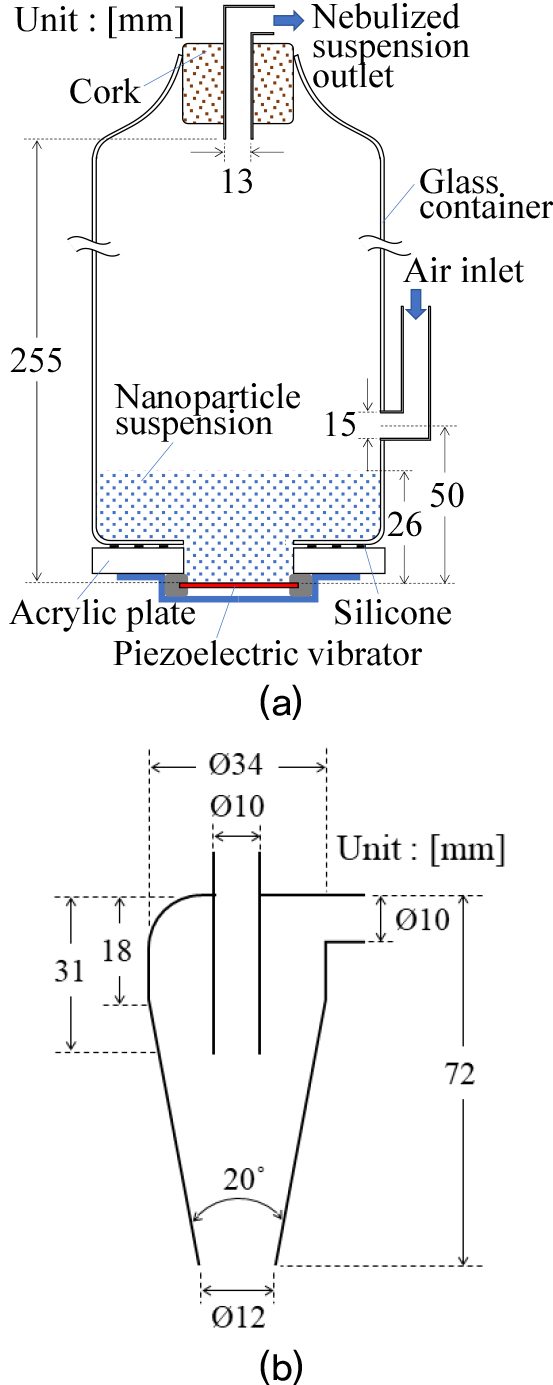
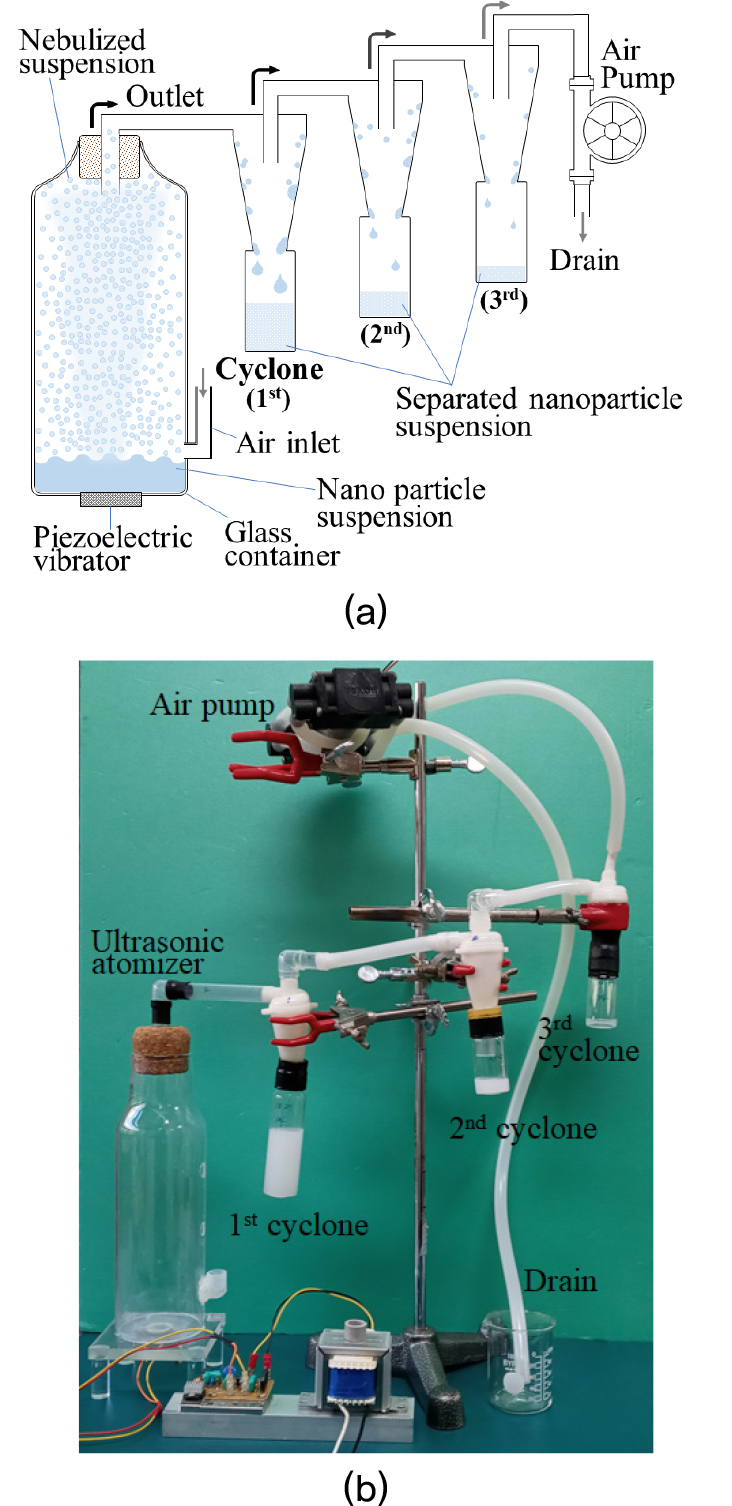
Fig. 2 shows the nanoparticle filtration system proposed in this study. Capillary waves are generated on the surface of the nanoparticle suspension by ultrasound radiated from the ultrasonic transducer. The nanoparticle suspension was scattered into the air in the form of atomized droplets by amplitude divergence of the capillary wave. Atomized droplets containing nanoparticles were transported into three cascaded cyclones with an air pump. In this process, atomized droplets that had lost their kinetic energy were collected and condensed into a liquid state. Particle size distribution of the suspension collected in a vial attached to the bottom of each cyclone was then measured using a particle size distribution analyzer (Litesizer 500, Austria). Wind speed sucked into the cyclone by the air pump was measured to be about 2.8 m/s. Referring to a study on cyclones of similar size, sizes of critical particles for the cyclone used in this study were thought to be about 6 μm.[13]
III. Results and discussion
In order to examine the resonant characteristic of the ultrasonic atomizer, input admittance of the piezoelectric vibrator with a radius of 20 mm and a thickness of 1.32 mm was measured. The resonant frequency appeared at about 1.625 MHz, and the value of conductance at resonance was about 525.4 mS. To measure the acoustic energy radiated from the ultrasonic transducer, the electro-acoustic conversion efficiency was measured. From the measured result, the electro-acoustic conversion efficiency was calculated as 83.4 %.[14,15] The ultrasonic transducer were supplied with an electrical power of 37.6 Wrms. From the electro-acoustic conversion efficiency, the acoustic power radiated from the ultrasonic transducer is therefore estimated as about 31.4 Wrms.
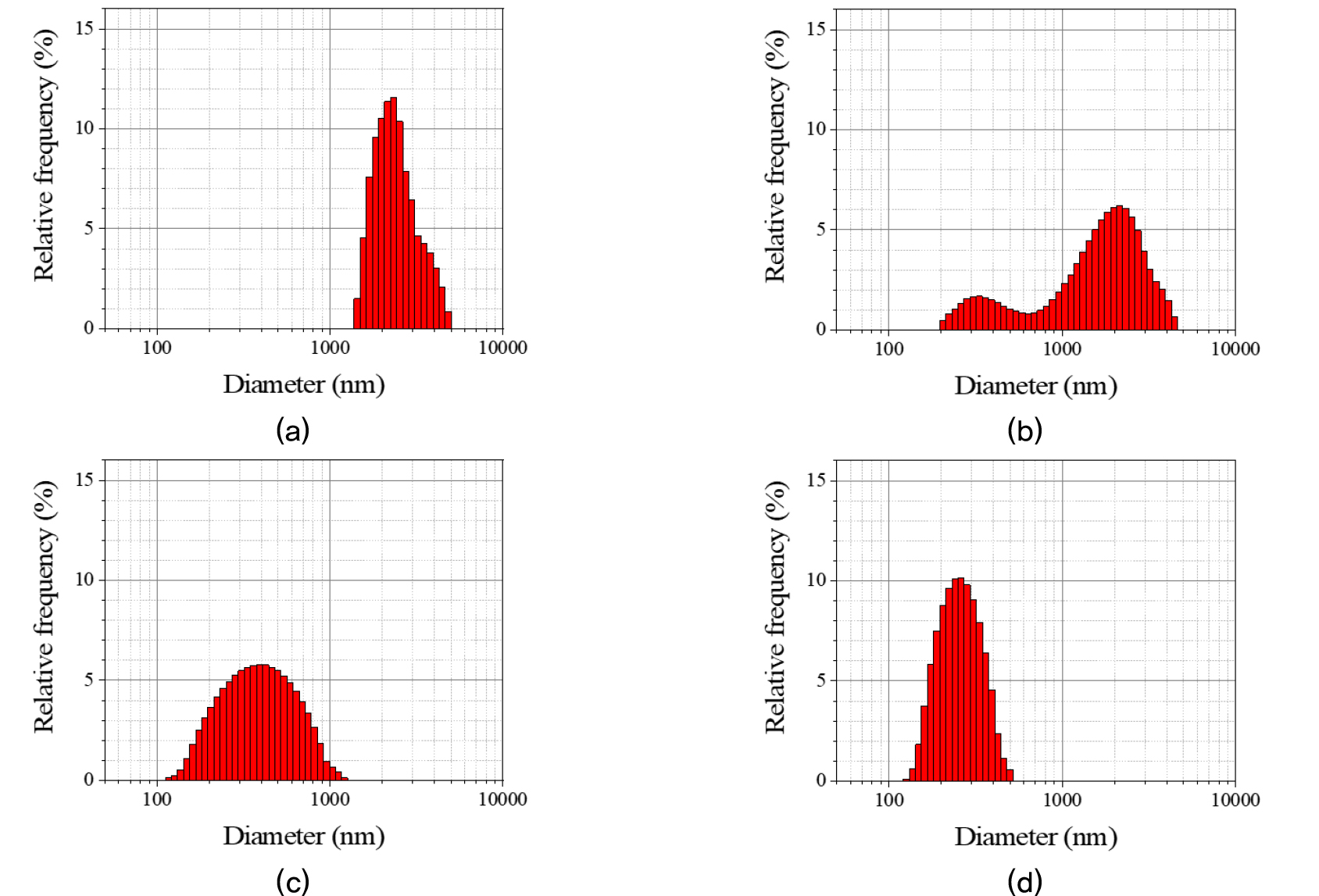
A suspension was blended with 199.0 ml of pure deionized water and 1.0 g of Al2O3 powder. The Al2O3 powder has 250 nm of average particle size (ARMSTEC IND. CO., LTD, Nano Al2O3). A suspension of Al2O3 nanoparticle was pre-dispersed for 10 min using a sonicator (SD-300H 200W) and then filtered for 60 min using the proposed filtration system. The amount of suspension filtered in each cyclone was different, the first was 83.91 wt%, the second 11.34 wt%, and the third 4.75 wt%. Particle size distribution of the suspensions filtered from the 1st, 2nd and 3rd cyclones and the suspension stirred were measured, respectively. Results are shown in Fig. 3. Values shown in the figure were averaged after repeated measurements on the same sample three times. Fig. 3(a) shows particle size distribution of the suspension in which only dispersion with a sonicator was performed. The diameter of the particle representing the mode appeared at 2324 nm, meaning that most number of particles maintained an agglomerated state. Particle size distribution of the suspension collected in the 1st cyclone after the ultrasonic atomization process is shown in Fig. 3(b). In this case, the diameter of the particle shown by the first peak was about 332 nm. It could be seen that monodispersed nanoparticles were included in the ultrasonic atomized droplet. However, since the mode showed more than 2000 nm, it could be seen that a large number of agglomerated particles were still included in the suspension. It was thought that the sum of the radiation force generated by ultrasonic energy and the suction force of the air pump were more significant than the gravity acting on the agglomerated particles. This could be overcome if the height of the outlet from the surface of the piezoelectric vibrator was long enough. Relatively light and small droplets that passed through the 1st cyclone were moved to the 2nd cyclone and become a suspension after condensing. The particle size distribution of this suspension is shown in Fig. 3(c). The diameter of the particle showing the mode was about 391 nm. The particle size was distributed over a relatively wide range up to about 1200 nm. This means that not only monodispersed nanoparticles, but also relatively light and fewer agglomerates passed through the 1st cyclone and reached the 2nd cyclone. To improve this problem, it is necessary to control the suction power of the air pump and design the cyclone so that sizes of particles collected are in a smaller range. The particle size distribution of the suspension filtered in the 3rd cyclone after passing through the 2nd cyclone is shown in Fig. 3(d). The mode of particle diameter was about 260 nm. Particle diameter distribution range was also limited to a relatively narrow region of about 125 nm to 498 nm. This implied that the particle size distribution of the suspension filtered in the 3rd cyclone was caused by monodisperse nanoparticles.
To investigate the variation in the particle size distribution of the filtered suspension with the pre-dispersion process, Al2O3 suspension with a 0.5 wt% concentration was pre-dispersed for 10 min using a homogenizer (STH750S, 225W). The filtration system injected with the dispersed suspension was driven for 60 min and the particle size distribution of the nanoparticle suspension filtered from the 1st , 2nd and 3rd cyclones was measured, as shown in Fig. 4. Fig. 4(a) shows the particle size distribution of the suspension dispersed using the homogenizer, the mode of particle diameter appeared about 1976 nm. This is similar to the distribution of the suspension dispersed using the sonicator, as shown in Fig. 3(a). There is no information about monodispersed nanoparticles or agglomerated particles having a small diameter due to agglomeration of relatively few particles. After through the ultrasonic atomization processing, the particle size distribution of the suspension obtained from the 1st cyclone was shown in Fig. 4(b). The size of particle diameter is distributed over a wide range of about 116 nm to 1976 nm, but unlike the result of Fig. 3(b), the mode appeared about 240 nm. This result signifies that the dispersion state of the suspension dispersed using the homogenizer was better than that dispersed using the sonicator.
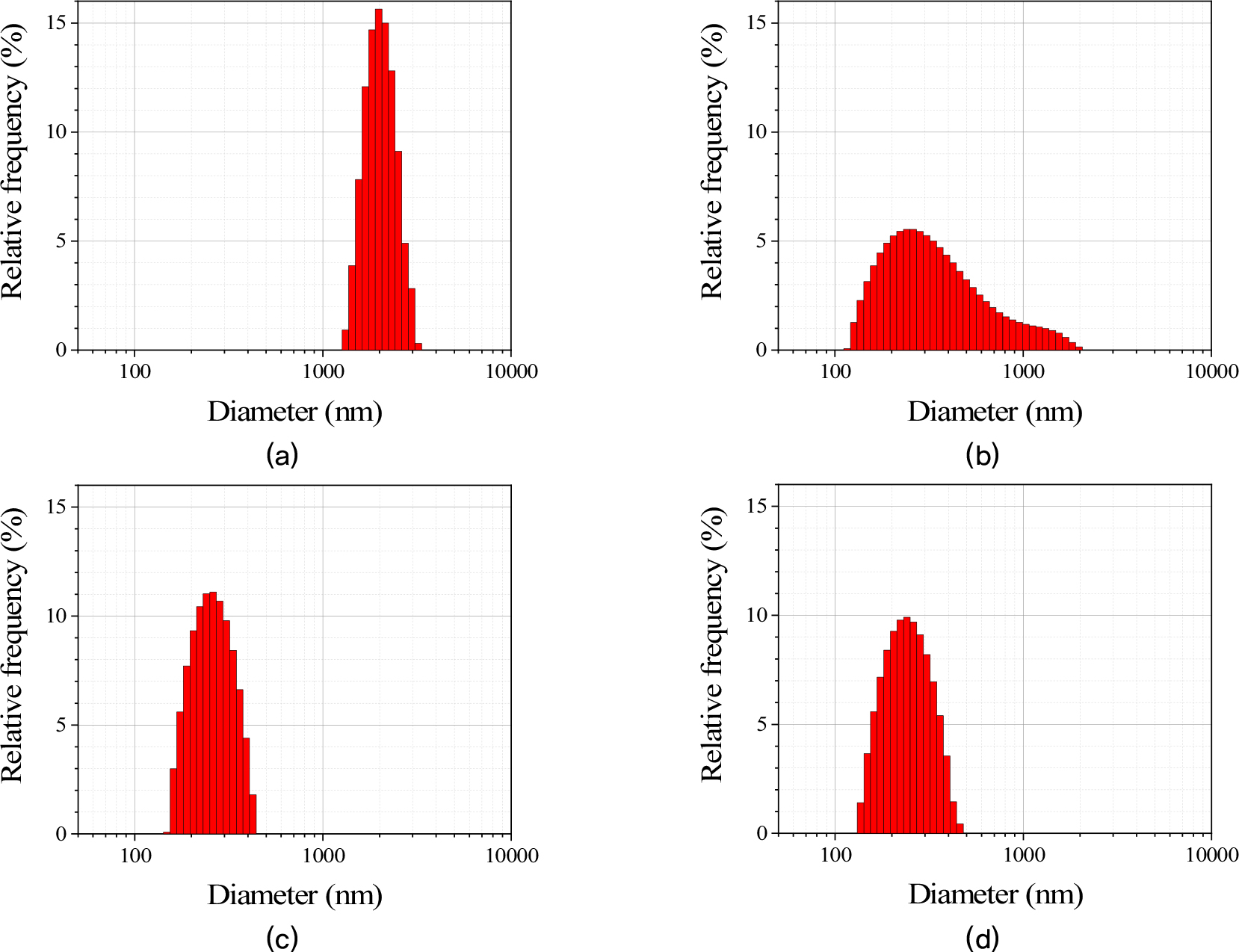
Fig. 4.
(Color available online) Particle size distribution of the Al2O3 filtered suspension after pre-dispersed with the homogenizer. (a) The original suspension, (b) suspension collected by the 1st cyclone, (c) suspension collected by the 2nd cyclone, and (d) suspension collected by the 3rd cyclone.
The particle size distribution of the suspension collected from the 2nd cyclone had a mode of about 260 nm, and the particle diameter distribution was also relatively narrow range, about 148 nm to 424 nm. This result is shown that the distribution of monodispersed nanoparticles could be obtained by two cyclones filtration. The distribution of the suspension collected from the 3rd cyclone of Fig. 4(d) have a mode of 240 nm and a distribution range of 136 nm to 460 nm. Since droplets containing monodispersed nanoparticles were already collected in the 2nd cyclone, it is similar to the result of the suspension collected from the 2nd cyclone.
These results demonstrate that it is possible to separate and filter only monodispersed nanoparticles from a nanoparticle suspension in which agglomerated particles are mixed.
IV. Conclusions
To remove agglomerated particles in a nanoparticle suspension, a filtration method using an ultrasonic atomization effect and cyclones was proposed. The validity of the proposed method was confirmed using a 0.5 wt% suspension made of Al2O3 nanoparticle powder with an average diameter of 250 nm. The Al2O3 suspension was pre-treated with two types of conventional dispersion methods, which are a sonicator and a homogenizer. By applying the proposed method to the suspension pre- dispersed with the sonicator, particle size distributions of suspensions filtered from the 1st, 2nd and 3rd cyclones were measured. As a result, while the mode of particle diameter in the pre-treated suspension appeared at 2324 nm, modes of particle diameters in the suspension filtered by the 1st, 2nd and 3rd cyclones gradually dwindled to 2143 nm, 391 nm, and 260 nm, respectively. Especially, in the case of the suspension pre-dispersed with the homogenizer, large agglomerate were removed from the suspension collected at the 2nd cyclone and then only monodispersed nanoparticles were distributed in the suspension collected at the 2nd cyclone.
These results verified the effectiveness of the proposed filtration method. They also confirmed that it is possible to separate and filter only monodispersed nanoparticles from a nanoparticle suspension in which agglomerated particles are mixed.