


I. Introduction
II. Current standards and guidelines for classroom acoustics
2.1 WHO Guidelines
2.2 American National Standards Institute (ANSI) S12.60-2009 and 2010
2.3 Building Bulletin 93: 2015 edition
2.4 Architectural Institute of Japan Environmental Standard (AIJES-S0001): 2020 edition
2.5 Association of Australian Acoustical Consultants (AAAC) guideline for educational facilities version 2: 2018 edition
2.6 Technical Design Requirements (TDR) for Alberta infrastructure facilities version 6: 2020 edition
III. Acoustical conditions and noise isolation in school classrooms in Korea
3.1 Elementary and high school classrooms
3.2 University classrooms
3.3 Comparisons of acoustical conditions in Korean school classrooms
IV. Speech intelligibility
V. Remarks
I. Introduction
There has been a growing body of research on the acoustics of classrooms and the problems of poor acoustics and noise on the students’ achievement at school.[1] Many of these studies have investigated how the acoustical conditions of classrooms influence students’ learning and performance at school and examined factors affecting speech intelligibility in the classroom. This leads to propose the acoustic standards and guidelines for classroom design in some countries.[2,3,4,5,6,7,8,9]
For schools, the sound level of the noise from both external sources outside the school premises and internal sources within the school premises should not exceed 55 dBA and this is the only regulation for acoustics of schools in Korea.[10] Here, external source background noise includes noise from transportation sources, such as aircraft, vehicle traffic, or from other noise sources outside the school premises. The background noise level in school premises should be measured with the windows opened and without occupants. This is the same value to the noise level in outdoor playgrounds in schools recommended in World Health Organization (WHO) guidelines.[2] Because the noise levels in classrooms are measured with the windows opened, the guideline value is different from the value in guidance for background noise levels measured with the windows closed during teaching activities in other countries.[2,3,4,5,6,7,8,9] In Korean school regulation,[10] there is no guidance on the acoustical performance criteria for background noise levels in enclosed classrooms, Reverberation Times (RT), and noise isolation design requirements. The three acoustical performance criteria are known to be important for achieving adequate speech intelligibility in school classrooms.[1]
The results of several acoustic survey of domestic and international classrooms at school showed that many classrooms are not met the requirements of the acoustical performance criteria defined in the standards.[11,12,13,14,15,16,17,18,19] The acoustical conditions vary room to room and school to school. The unoccupied data on the acoustics of classrooms are related to various physical characteristics of the rooms. The occupied data on the acoustical conditions and noise levels in the classrooms show the effect of students on the acoustical conditions in active classrooms, emphasizing the need for design criteria for occupied conditions for teaching and learning spaces.[15,16,17,18,19]
The results of several acoustic survey of domestic classrooms in elementary/primary school, high/secondary school,[11,12,13] and university[14,15,16] are based on the field measurements reported in some of previous studies. There are quite limited results reported on the acoustical characteristics of Korean school classrooms, especially for speech communication in actual classroom situations with realistic ambient noises and instructor’s speech voices. The acoustical characteristics of elementary and high school classrooms are measured for unoccupied conditions so that the acoustics experienced in real classroom situations would be different from the measured values without occupants. There are a significant effect of the presence of students and their activities on the acoustical conditions in classrooms.[16,17,18] They are also known to be significantly related to the background noise levels and the Signal-to-Noise Ratios (SNR) during actual class situations.[16,17,18]
This paper describes the acoustical conditions of elementary and high school classrooms as well as university classrooms in Korea and suggests a need for Korean acoustic standards and guidelines for classroom design. Firstly, current standards and guidelines of classroom acoustics in several countries were briefly introduced. Next, the results of several acoustic survey of domestic classrooms at school were described and compared to provide information of the acoustic characteristics of Korean classrooms. The survey includes occupied and unoccupied data on the acoustical conditions, noise levels, and noise isolation performance in the classrooms. Finally, acoustical parameter values for achieving ‘good’ speech intelligibility in active university classrooms were discussed.The present work may not be valid in classrooms with speech-reinforcement systems in operation (e.g. classrooms used for English listening tests).
II. Current standards and guidelines for classroom acoustics
Many countries have developed new or revised standards for classroom design and the World Health Organization includes recommendations for schools in its Guidelines for Community Noise.[2,3,4,5,6,7,8,9] Most standards include guidance on the acoustical performance criteria for background noise levels and reverberation times, and noise isolation design requirements in various types of classrooms. As described in previous section, there is only one regulation for acceptable noise levels (≤55 dBA) in the school premises in Korea.[10] In this section, the six standards and guidelines of classroom acoustics in different countries are summarized and compared.
2.1 WHO Guidelines
Table 1 presents recommendations for schools in its Guidelines for Community Noise by the World Health Organization in 1999.[2] In classrooms for schools and preschools, the background noise level should not exceed 35 dB LAeq during teaching activities. For outdoor playgrounds the noise level should not exceed 55 dB LAeq, the same value as for outdoor residential areas in daytime. The reverberation time in the classrooms should be about 0.6 s. For assembly halls and cafeterias, the reverberation time should be less than 1 s. It is not clear whether the RT value refers to an occupied or unoccupied conditions. For hearing impaired students, a lower noise level and RT value in classrooms are required.
Table 1.
WHO guidelines for background noise levels and reverberation times in schools.[2]
| Background noise level, dB LAeq | Reverberation times, s | |
| Classrooms | ≤35 | 0.6 |
| Halls and cafeterias | - | ≤1.0 |
| Outdoor play ground | ≤55* | - |
2.2 American National Standards Institute (ANSI) S12.60-2009 and 2010
The first American national standard published in 2002 was revised. and divided into two parts in 2009 and 2010. The first part of the revised standard is for acoustical design requirements of permanent schools, and refined version of the 2002 standard.[3] The second part is the acoustical performance criteria requirements for relocatable classrooms.[4]
The ANSI standard provides design criteria and guidelines for new and refurbished classrooms and other learning spaces in Table 2. The 1 h average background noise level should not exceed 35 dB LAeq during leaning activities in unoccupied furnished core learning spaces with volumes of 283 m3 or less and classrooms with volumes of 283 m3 ~ 566 m3. The reverberation time in the mid-frequency bands of 500 Hz, 1,000 Hz, and 2,000 Hz should not exceed 0.6 s in classrooms with volumes of 283 m3 or less and 0.7 s in classrooms with volumes of 283 m3 ~ 566 m3. For relocatable classrooms, the reverberation time should not exceed 0.5 s in classrooms with volumes of 283 m3 or less and 0.6 s in classrooms with volumes of 283 m3 ~ 566 m3.
Table 2.
Acoustical performance criteria and design requirements for school classrooms according to ANSI S12.60-2009 and 2010.[3.4]
| Learning space |
Background noise level, dB LAeq | Reverberation timesa), s |
Airborne sound insulationb), STC |
Impact sound insulationc), IIC |
| Core learning spaces ≤ 283 m3 | ≤35 | 0.6 (0.5)d) | 50 | 45 |
|
Core learning spaces > 283 m3 and ≤ 566 m3 | ≤35 | 0.7 (0.6)d) | ||
|
Core learning spaces > 566 m3 and all ancillary learning spaces | ≤40 | - | 60 | 40 |
Both parts of the ANSI standard also provide sound insulation requirements for airborne sound transmission between core learning spaces and adjacent spaces in permanent and relocatable classrooms. The minimum Sound Transmission Class (STC) rating between two core leaning spaces is 50, between a core learning space and corridor 45, and between a core learning space and music room 60. The minimum Impact Insulation Class (IIC) rating for structure-borne sound transmission is IIC 45 for rooms located above core learning spaces, and IIC 40 for rooms located above ancillary learning spaces in permanent classrooms. The IIC rating for relocatable classrooms is IIC 50 if above core learning spaces and IIC 45 if above ancillary learning spaces.
2.3 Building Bulletin 93: 2015 edition
Building Bulletin 93 is a comprehensive document specifying indoor ambient noise levels, reverberation times, and sound insulation requirements for various types of teaching and learning spaces in schools. The 2003 edition of Building Bulletin 93 (BB93:2003) is revised, and published in 2015.[5] The revised version of BB93 apply to unoccupied furnished classrooms and to refurbishments as well as to new buildings. The new Speech Transmission Index (STI) requirements for open plan spaces are included to provide both sufficient speech intelligibility within groups and suitable speech privacy between groups in the revised version of BB93. The 2015 edition of Building Bulletin 93 also provides the requirements to students with special hearing or communication needs.
Table 3 presents some examples of the acoustic performance standards and their maximum values for background noise levels, in terms of LAeq,30mins, and reverberation times in unoccupied, furnished learning spaces. The reverberation time is the mean values in the mid-frequency bands of 500 Hz, 1,000 Hz, and 2,000 Hz. The sound insulation requirements for airborne sound transmission of walls and for impact sound transmission of floors are also included in Table 3.
Table 3.
Acoustic performance standards for school classrooms according to Building Bulletin 93: 2015.[5]
| Learning space |
Background noise level, dB LAeq,30 min |
Reverberation timesa), s |
Airborne sound insulationb), dB DnT,W |
Impact sound insulationc), dB L’nT,W |
|
Primary school classrooms | ≤35 | ≤0.6 | 45 | 60 |
|
Secondary school classrooms | ≤35 | ≤0.8 | ||
|
Open plan teaching area | ≤40 | ≤0.5 | 45 | 60 |
|
Teaching space for students with special hearing and communication needs | ≤30 | ≤0.4d) ≤0.6 every octave bands | 50 | 55 |
The 30 min average background noise level should not exceed 35 dB LAeq during leaning activities in classrooms. For open plan spaces, the maximum background noise level is 5 dBA higher than those for closed spaces. The mid-frequency reverberation time should be less than 0.6 s in classrooms and 0.5 s in open plan teaching areas. Teaching spaces for students with special hearing or communication needs are required the reverberation time averaged from 125 Hz to 4 kHz less than 0.4 s. The performance criteria for open plan spaces should be achieved in conjunction with a STI value higher than 0.6 within groups, and with a STI value lower than 0.3 between groups.
The airborne sound insulation is assessed in terms of the weighted standardized level difference, DnT,W. Here the reference reverberation time T is the upper limit of the specified RT for the receiving room. The minimum required values of DnT,W range from 35 dB for the insulation between a source room with average activity noise and a receiving room with a high tolerance level to 55 dB between a source room with very high activity noise and one with low tolerance. The impact sound insulation is assessed in terms of the weighted standardized impact sound pressure level, L’nT,W. The maximum required values of L’nT,W range from 55 dB for rooms specially for students with special hearing or communication needs to 65 dB for dining rooms, administration and ancillary spaces.
2.4 Architectural Institute of Japan Environmental Standard (AIJES-S0001): 2020 edition
The standard and design guidelines for sound environment in Japanese school buildings was first published in 2008 and revised in 2020.[6] This standard is published by the Architectural Institute of Japan and provides the acoustical performance criteria of background noise levels, sound insulation and reverberation time in unoccupied furnished school rooms. The 2020 edition of AIJES also include guidelines for children with special acoustic needs and preschool children. The design guidelines for the acoustic performance of wooden and steel-frame construction were added to the revised version of AIJES.
The maximum required background noise level range from 35 dB LAeq for classrooms with hearing impaired students to 45 dB for gymnasium.. The mean reverberation time at 500 Hz and 1,000 Hz should not exceed 0.6 s in classrooms with volumes of 200 m3 or less and 0.7 s in classrooms with volumes of 300 m3 or less.
The airborne sound insulation is assessed in terms of the mean value of the sound level difference in octave bands from 125 Hz to 2 kHz. The minimum required values range from 40 dB in rooms for speech communication to 60 dB in rooms for activities. The impact sound insulation is assessed in terms of the A-weighted sound pressure level, LA. The maximum required values of LA range from 40 dB in rooms for activities to 55 dB in rooms for speech communication.
2.5 Association of Australian Acoustical Consultants (AAAC) guideline for educational facilities version 2: 2018 edition
The AS/NZS 2017: 2016 “Acoustics-Recommended design sound levels and reverberation times for building interiors” standard provides noise levels for certain spaces, but not comprehensive for educational facilities.[7] The AAAC guideline provides acoustical performance criteria of background noise levels, reverberation time, and sound insulation between areas.[8]
The recommended background noise level, LAeq, should be 35 dBA-40 dBA in teaching spaces for primary and secondary schools. The maximum required background noise level range from 30 dB LAeq for classrooms with hearing impaired students to 45 dB for open plan spaces. The reverberation times should be less than 0.6 s in typical classrooms and open plan spaces and 0.4 s in teaching spaces for hearing impaired students. The performance criteria for open plan teaching spaces should be achieved with a STI value higher than 0.7.
The maximum required value of L’nT,W for impact sound insulation in teaching spaces is 60 dB. The minimum required values of the weighted sound level difference between two rooms, DW, for airborne sound insulation in teaching spaces is 40 dB.
2.6 Technical Design Requirements (TDR) for Alberta infrastructure facilities version 6: 2020 edition
The TDR document provides the specific requirements for school rooms where speech privacy, sound isolation, background noise, and reverberation is critical.[9] The mean reverberation time at 500 Hz, 1,000 Hz, and 2,000 Hz should not exceed 0.6 s in unoccupied classrooms. The minimum wall Apparent Sound Transmission loss requirements (ASTC) should be 45. The acceptable background noise level in terms of Room Criteria (RC) is 25-30 for classrooms.
III. Acoustical conditions and noise isolation in school classrooms in Korea
3.1 Elementary and high school classrooms
A few acoustical measurements performed in unoccupied classrooms in elementary and high schools in Korea.[11,12,13] The mean mid-frequencies T30 value in 9 elementary school classrooms[11] (room volumes: 140 m3 ~ 200 m3) was 0.75 s for unoccupied conditions. The mean C50 (clarity) values averaged from the frequency bands 500 to 4 kHz were varied from 2 dB to 3 dB. The mean STI value was 0.65, but it is unclear if the measurement made with the room air conditioner operation.
Another acoustical measurements in 15 elementary and high school classrooms[12] showed that the mid-frequencies T30 value varied from 0.35 s to 0.74 s for unoccupied conditions.The room volumes varied from 160 m3 to 458 m3. The mean D50 values varied from 60 % to 80 %. The mean STI value varied from 0.70 to 0.85, but it is not known if the measurement made with the room air conditioner operation. The measured mean indoor noise levels for unoccupied classrooms without the air conditioner operation varied from 31 dBA to 34.3 dBA.
The acoustic survey of secondary school (high school) classrooms from relatively small classrooms to very large sports halls (volumes ranged from 116 m3 to 11,000 m3) in England showed that unoccupied acoustic conditions affect the noise levels occurring during classes.[19] The results showed that both background (LA90) and ambient (LAeq) noise levels during actual classes were related to the unoccupied indoor ambient noise levels and mid- frequency RT values. The acoustic design should aim to reducing the unoccupied room noise levels and RT values to minimize noise levels during classes.
There is few data on the measurements of noise insulation performance in Korean elementary school classrooms.[13] The value of airborne sound insulation of outer walls (Dls,2m,nT,W) in two elementary school classrooms with window closed were 25 dB and 28 dB. The value of airborne sound insulation of walls between the two classrooms (Apparent Sound Transmission Class, ASTC) were 40 and 46 and the values of DnT,W were 43 dB and 46 dB. There was no measurement data on the impact sound insulation performance in the same classrooms.
3.2 University classrooms
The acoustic survey of 12 university classrooms[14]from relatively small classrooms to very large conference halls (volumes ranged from 188 m3 to 2,535 m3) in Korea showed that the effect of added absorption of occupants is dependent on the acoustical conditions of unoccupied classrooms. The mean mid-frequencies T30 value for unoccupied 12 classrooms varied from 0.31 s to 1.81 s. The mean mid-frequencies T30 value for the same occupied classrooms (58 % occupancy) varied from 0.26 s to 0.89 s. The mean background noise levels for occupied and unoccupied classrooms with the air conditioner operation were 41.2 dBA and 40.2 dBA, respectively. The results indicate that the background noise levels both with and without occupants exceed the recommended value of 35 dBA. The noise generated by adult students increased typically 1 dBA.
Another acoustic survey of 11 Korean university classrooms[15] having a small to medium sized volume (188 m3 to 343 m3) showed that the mean mid-frequencies T30 value for unoccupied classrooms varied from 0.61 s to 1.80 s. The mean mid-frequencies T30 value for the same occupied classrooms (65 % occupancy) varied from 0.37 s to 0.90 s. The noise levels in active classrooms with the air conditioner operation varied from 40.3 dBA to 47.6 dBA.The noise generated by adult students increased the noise levels by 0.9 dBA and the increases varied up to a maximum of 3.7 dBA relative to the same classrooms for quietly occupied classrooms without activities.
The two Korean university classroom acoustics studies[14,15] showed a significant effect of the presence of occupants on the acoustical conditions in classrooms, emphasizing the need for design criteria for occupied conditions for teaching and learning. The present results agree well with the two previous studies.[17,18]
The mean noise levels measured both in elementary school classrooms and university classrooms[17,18]during real classes can vary from 43.7 dBA to 49.1 dBA due to the noise generated by occupant’s activity, especially for younger children. The mean noise levels during actual lectures in the two different university classrooms[15,17] were not as high as those measured in the elementary school classrooms[18] with student activities, but indicated that the received speech levels at listener’s positions should exceed 59.4 dBA for obtaining a desirable SNR value of +15 dBA. The measured data during actual lecture situations in the two different university classrooms[15,17] clearly showed that achieving a received speech level of 59.4 dBA at listener’s positions would not be easily accomplished.
The adult students in university classrooms generate less noise increases than the younger students in elementary school classrooms during classes.[15] That is, the adult students mostly remained quieter during actual lecture situations. Therefore, the most practical way to minimize the noise levels during actual classes in university classrooms would be to reduce noises generated from ventilation systems, other adjacent rooms, and outdoors.
In 21 % of cases, the speech intelligibility test scores were less than 95 % correct speech intelligibility when measured in the same university classrooms with realistic ambient noises presented.[16] In occupied facilities, activity noises generated in one space can be transmitted through walls, and doors to adjacent spaces, thus increasing the overall background noise level in those spaces. The entrance doors with inadequate seals may have sound insulation problems with classrooms adjacent to a hallway and result in obtaining lower speech intelligibility scores. Further work should be carried out to discover where there is more sound energy being transmitted from the classroom for better assessing sound insulation problems with classrooms adjacent to a hallway.
The two standard methods are very similar and include single number ratings to convert the results at a number of frequencies to a single value. They can be converted into a single number, weighted apparent sound reduction index (Rw´), by application of ISO 717-1.[20]Rw´ is similar to the Apparent Sound Transmission Class (ASTC) from the American Standard Test Method (ASTME) 413 standard.[21] The ASTC ratings for the 12 composite walls in the university classrooms ranged from 21 to 32. The mean ASTC rating for the 12 composite walls in the university classrooms was 26 (s.d. = 3.3). The present results show that no composite wall met the requirement for STC rating of 45.[3] There is only one classroom that met the requirement for STC rating of 30 or more for its entrance door into the classroom. This classroom had steel entrance doors with door seals around the perimeter of the doors.
The mean value of ASTC for the 12 composite walls of university classrooms is lower than the values measured in the two elementary school classrooms. All university classrooms were adjacent to central hallways through their side walls. The classrooms had one to three entrance doors in the side wall. Most entrance doors in the side wall were made of wood with inadequate door seals. Poor sound insulation of walls between the classrooms and the hallways was expected. Some classrooms also had high windows in the side wall.
3.3 Comparisons of acoustical conditions in Korean school classrooms
Table 4 compares the mean measured acoustical parameter values of the background noise levels, the mid- frequency T30 values, the STI values, and the ASTC values in elementary and high school classrooms[11,12,13] as well as university classrooms.[14,15] Two acoustical survey of elementary school classrooms showed that the mean STI values for unoccupied conditions are higher than the measured values in university classrooms. This is probably due to shorter T30 values and lower background noise levels less than 34.2 dBA for unoccupied classrooms. The background noise levels measured in the unoccupied university classrooms are 6 dBA ~ 9 dBA higher than the measured values obtained in elementary and high school classrooms. The noise levels in university classrooms were measured with the air conditioner operation.
Table 4.
Comparisons of mean measured acoustical parameter values of the background noise levels, reverberation times, speech transmission index, and apparent sound transmission class in Korean classrooms.
| Classrooms | Volume, m3 | Background noise level, dBA | Reverberation times, s | STI |
Apparent Sound Transmission Class (ASTC) | |||
| Unoccupied | Occupied | Unoccupied | Occupied | Unoccupied | Occupied | |||
|
Elementary school[11] |
166 (s.d. = 20) | - | - |
0.75a) (s.d. = 0.16) | - |
0.65b) (s.d. = 0.06) | - | - |
|
Elementary school[12,13] |
168 (s.d = 9) | 34.2b) | - | 0.57a) | - | 0.70 ~ 0.85b) | - |
43 (s.d. = 4) |
| High school[12] |
257 (s.d. = 134) | 33.2b) | - | - | - | - | - | - |
| University[14] |
699 (s.d. = 707) | 40.2 | 41.2 |
0.96c) (s.d. = 0.47) |
0.67c) (s.d. = 0.20) |
0.61 (s.d. = 0.1) |
0.63 (s.d. = 0.05) | - |
| University[15] |
257 (s.d. = 38) |
43.2 (s.d. = 2.8) |
43.8d) (s.d. = 2.0) |
1.12c) (s.d. = 0.41) |
0.64c),d) (s.d. = 0.15) | - |
0.55d) (s.d. = 0.04) |
26 (s.d. = 3.3) |
The US and UK standards[2,4] clearly state that the background noise levels should include both the external sources outside the school premises and internal sources within the school premises. The background noise level indicates sound levels measured in a furnished, unoccupied learning space, including sounds from outdoor sources, building services and utilities. The background noise excludes sound generated by people within the building or sound generated by temporary or permanent instructional equipment. Here, interior-source background noise indicates noise from building services and utilities. Exterior-source background noise indicates noise from transportation sources, such as aircraft, vehicle traffic, or from other noise sources (e.g. lawn maintenance, playground activities, or industrial sources). None of the two measurements in Korean elementary school classrooms included both the internal and external noise sources in the school buildings.
In Table 4, the two acoustic survey of university classrooms showed that the presence of students contributed on obtaining shorter T30 values due to added absorption by occupants. This indicates that the T30 values are likely to be more shorter than the values obtained in real classrooms with added students. The acoustic survey of high school classrooms in England reported that both background (LA90) and ambient (LAeq) noise levels during actual classes were related to the unoccupied indoor ambient noise levels and mid-frequency RT values. The acoustic standards and guidelines for classroom design should recommend reducing the unoccupied indoor noise levels and RT values to minimize noise levels during actual classes.
The mean ASTC value of walls between the two elementary school classrooms was 43. The mean ASTC rating for the composite walls with entrance doors in the 12 university classrooms was 26. The sound insulation of walls without doors and windows measured in the elementary school classrooms was a lot better than the composite walls with windows and doors measured in the university classrooms. This is because most entrance doors in the side wall are made of wood without adequate door seals.
IV. Speech intelligibility
The acoustical design of classrooms for achieving ‘Good’ speech intelligibility requires an optimization process. The optimization process is to minimize ambient noise levels to achieve acceptable SNR values, which is a SNR value of 15 dBA for normal hearing students. More higher SNR values of 15 dBA or 20 dBA are recommended for hearing impaired students by the American Speech-Language-Hearing Association[22] and the British Association of Teachers of the Deaf.[23] The SNR component is more important for obtaining the optimum conditions for speech communication in classrooms. Achieving an optimum reverberation time is of secondary importance because the optimum reverberation time varies when SNR values are changed.[24]
A speech intelligibility test was performed to propose the acoustical performance criteria using auralized speech signals in a virtual model of Korean standard classroom having a volume of 172.8 m3.[25] The volume of standard classroom was taken from the average values of 17 elementary school classrooms (grade 7 to 9) and 7 high school classrooms. The RT used for the tests ranged between 0.47 s and 1.22 s and the RT values were approximately 0.28 s to 0.39 s shorter than the measured values in real classrooms without students (0.75 s to 1.61). Although the RT values are taken from the measurement data in the real classrooms, the RT values are likely to be more shorter than the values experienced in real classrooms with students. During the tests, a SNR value of 15 dBA was used. That is, the results would not include the effect of varied SNR values on the speech intelligibility for listeners. Furthermore, the speech intelligibility scores were obtained from adult listeners at university aged between 20 to 27 years old with normal hearing senses, instead of obtaining from elementary and high school children. They claimed that hearing ability for students over the age of 14 is similar to adult listeners. This is contrary to the findings reported in other study that insists high school children will also be disadvantaged by poor acoustic environments.[19]
Both room acoustics and background noise effect on the optimum conditions for speech communication in classrooms.[24,26] There is a range of C50 values for every SNR value that lead to acceptable conditions for good speech communication in classrooms. Similarly, for every C50 value there is a range of SNR values for optimum conditions in classrooms. Two measures, STI and Useful- to-detrimental sound ratios (U50) are known as complete predictors of speech intelligibility in classrooms because they include both a measure of room acoustics quality as well as a measure of speech-to-noise-ratios.[26,27]
Fig. 1 plots multiple regression results for predictions of both U50 (125-4 k) and STI values from combinations of C50 (125-4 k), and SNR (125-4 k) values.[15] When the classroom has a U50 (125-4 k) value of 6.2 dB or greater a SNR(125-4 k) value of 10 dBA or greater to be required for achieving ‘Good’ or ‘Excellent’ acoustical conditions for both measures, U50 and STI, in active university classrooms. However, the required C50 (125-4 k) value is slightly different for both measures if the classroom has higher or lower SNR (125-4 k) values of 10 dBA.
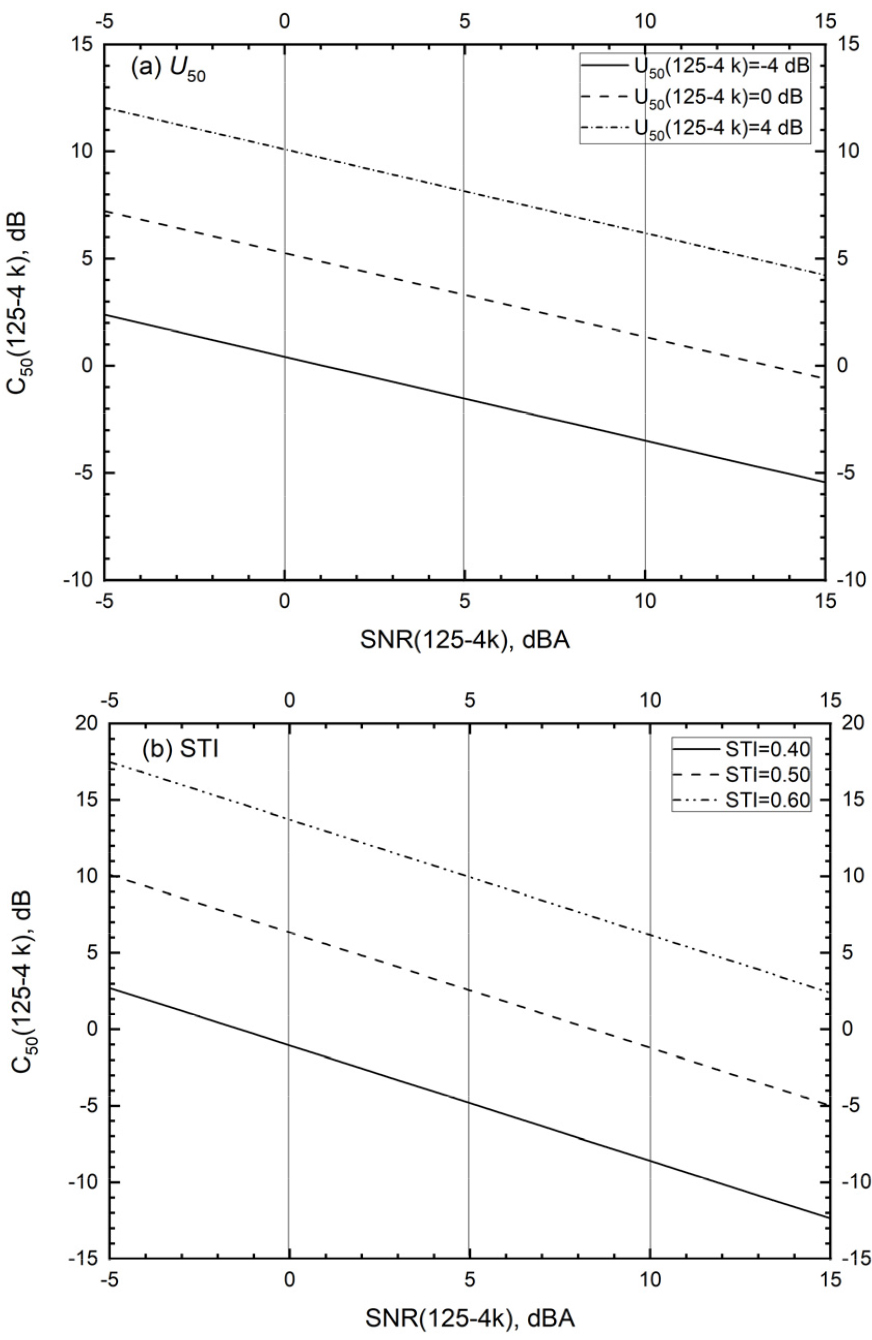
Fig. 1.
Multiple regression results for predicted (a) U50 (125-4 k) and (b) STI values from combinations of C50 (125-4 k), and SNR (125-4 k) values.[15]
If the classroom has a higher SNR(125-4 k) value, which is 15 dBA or greater, a C50 (125-4 k) value of 4.1dB or greater to be required for achieving U50 (125-4 k) values of about +3.9 dB, but a slightly lower C50 (125-4 k) value (2.4 dB or greater) is required for achieving a STI value of 0.60. Whilst if the classroom has a lower SNR (125-4 k) value, which is 5 dBA or greater, a C50 (125-4 k) value of 8.1 dB or greater to be required for achieving U50 (125-4 k) values of about+3.9 dB, but a slightly higher C50 (125-4 k) value (10 dB or greater) is required for achieving a STI value of 0.60.
Classroom quality was strongly correlated with the background noise level and the related signal-to-noise ratios, emphasizing the need for the design criteria for occupied classrooms. The speech and noise levels are quite different from values measured in active classrooms with the influence of noise due to student activity.[15,17,18] In most cases, the ideal goal of a SNR value of +15 dB seems to be rarely achieved in active classrooms.[15,17,18] It is more difficult to measure these parameters in occupied classrooms and hence being able to predict values of these acoustical parameters for real speech communication is a great asset to achieving acoustically successful classrooms. There is a clear need for more representative data and complete understanding of speech and noise levels in occupied classrooms with teaching activities.
V. Remarks
Many research clearly show the need to create good acoustical conditions for achieving high speech intelligibility for both children and adult students in classrooms. Some countries have proposed acoustic design guidelines for school classrooms to provide better acoustics for speech communication.[2,3,4,5,6,7,8,9] The younger the age the greater the effect of noise and reverberation with children under about 13 years of age being particularly important.[1,24] Children and adults who are hearing impaired are more affected by noise and reverberation time than those with normal hearing senses.[22,23] The acoustic surveys of classrooms in elementary and high schools show that classroom noise levels can be high, particularly during actual classes, and that this is often due to the noise generated from classroom activity.[18,19] The room acoustic factors that mostly affect speech intelligibility are the signal-to-noise ratio.[15,18,24,26] As the talkers' voice levels vary, it is particularly important to reduce the background noise level during classes.[15,17,18] The acoustical design of classrooms should aim to reducing the unoccupied room noise levels with acoustic treatments and RT values to minimize noise levels during classes.[19]
As previously discussed in section 3.3 and Table 4, there are quite limited valuable data on the acoustic survey of Korean elementary and high schools.[11,12,13] Firstly, the background noise levels should measure both the external sources outside the school premises and internal sources within the school premises. Secondly, the effects of added occupants in classrooms should be measured to get better understand the occupied room acoustical conditions, such as T30 values, C50 values, and SNR values. Next, both the airborne sound insulation and the impact sound insulation should be measured to minimize the background noise levels and to create more quieter learning spaces. Finally, the requirements of the acoustical performance criteria defined in the standard should be used for achieving ‘Good’ speech intelligibility in school classrooms. Therefore, further investigation should be carried out to propose the acoustical performance criteria for background noise levels and reverberation times, and noise isolation design requirements in various types of classrooms in educational buildings in Korea. It is hoped that the research findings presented in this paper can give a clear insight of the need for Korean standard on classroom acoustics.