


I. Introduction
II. Materials and Methods
2.1 Subjects
2.2 Experimental Procedure
III. Results and Discussion
3.1 Effects of sensitive placement at noise condition
3.2 Comparison of sensitivity at quiet to noise condition
3.3 Effects of protection methods
3.4 Effects of noise directions
IV. Conclusions and Suggestion
I. Introduction
Noise is all around us. Unlike acoustic trauma damage from a one-time exposure to an extremely intense sound, noise-induced hearing loss (NIHL) develops gradually through repeated exposure to loud sounds over a period of time.[1] Generally, NIHL damage appears at high frequencies in the cochlea first (i.e., near 4,000 Hz), and then spreads to nearby frequencies.[2] Although clinicians have long known that NIHL is a permanent but entirely preventable hearing loss, the percentage of the population who suffer from NIHL related to occupational and non-occupational activities (i.e., about 15 % of Americans) has not decreased.[3] In other words, the onset as well as the degree of this permanent NIHL should be controlled in terms of prevention, although hair cell loss in the cochlea, once the cells are damaged, is irreversible. Therefore, the trend in industrial audiology has been to focus more on prevention than on aural rehabilitation, treating the condition after the damage has occurred.[4]
In 2010, Park et al. tested 82 shipyard company employees with NIHL in order to evaluate their speech intelligibility in workplace noise while wearing hearing protection devices.[5] The results showed a positive effect of the protection devices for the hearing-impaired employees to reduce the amount of noise with high frequencies, compared to normal-hearing listeners. However, the hearing-impaired employees’ speech perception did not differ under either the protected or unprotected condition. We claim here that Park et al.’s study only used the air conduction pathway in order to present both speech stimuli and various types of noise. This might describe the current situation in many noisy companies; it requires the employees to wear the protection device over the pinna, but also to communicate through the external ear canal. That is, employees might find it difficult to differentiate the wanted speech sounds from the unwanted noise because of using only “one route”, the air conduction pathway. In the conclusion, the researchers suggested that workers could be trained to pronounce words more loudly and more clearly when they were wearing hearing protective devices.[5] However, this suggestion would teach the workers to wear some protection devices, yet did not help create effective communication for the workers. Such suggestion ultimately leads to workers not wearing the protection devices. For example, a survey study by Morata et al.(2001) reported that the main reason why workers do not consistently use the hearing protectors to combat noise was less efficient communication with other workers (70 %),[6] a finding that was also supported by a study from Helmkamp (1986).[7] Therefore, our current study tries to find a solution for the workers, while using two pathways known as air and bone conductions.
In many industrial countries, dual systems that consider both hearing protection and communication have been developed for a number of years. The workers could be communicating by the bone conduction pathway, while simultaneously protecting the air conduction pathway such as the pinna and the external ear canal.[8-9] Bone conduction is the process of receiving and transmitting acoustic signals through vibrations of the skull. At that time, the cochlea is also stimulated by the vibration of the skull bones. That is, the bone conduction interface provides coupling between the mechanical vibrator and the cochlea through the bones of the skull, during which the air conduction pathway is covered by the protection device against the noise. One of the advantages of the dual system is that it enables the listener to communicate with the least intrusion from background noise, resulting in better communication.[10] In particular, since rescue and military operations require individuals to convey auditory signals over the environment to a partner while protecting themselves from the hazardous effects of noise, U.S. government organizations, such as the Department of Defense, Fire and Rescue Departments, and FEMA, the Federal Emergency Management Agency, have become more interested in the dual system and have developed bone conduction technology.[11] These organizations sometimes face situations during which, if the rescue and military personnel hear a signal but misinterpret it, they could convey the wrong message to a partner and face capture or even death from their enemy.[8]
The purpose of the present study is to find the most sensitive placement of the skull in order to perceive speech through the bone vibrator in various protection methods while being exposed to noise. We offer three hypotheses: 1) Of the five different placements of the human skill, there is one that is the most sensitive. 2) There are significant differences among the four protection methods we used. 3) Also, there is a significant difference in the threshold among the four noise directions. Results of the present study may provide better and more effective hearing protection protocols under hazardous noise conditions, as well as better communicative devices for employees in a noisy work environment.
II. Materials and Methods
2.1 Subjects
A total of 20 (10 male and 10 female) participants between the ages of 18 and 30 were randomly recruited in Chuncheon community (mean: 22.3 years old; standard error: 1.525). The participants reported a negative history of head or neck abnormalities, ear surgery, otologic disease, or head trauma.
They also passed normal criteria of the hearing screening to ensure A-type of tympanogram, a sensitivity of 15 dB HL or better in each ear at 250 to 8,000 Hz, and air-bone gaps no greater than 5 dB HL.
2.2 Experimental Procedure
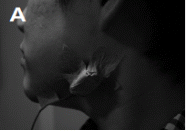
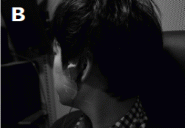
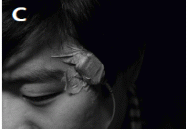
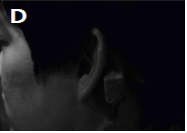
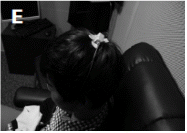
Behavioral bone-conducted thresholds were obtained using Korean spondee words, which included 5 modified lists of KS-WL-A[12] to avoid learning effect, from 5 oscillator placement locations (i.e., jaw angle, condyle, temple, mastoid, and vertex; see Fig. 1). The order of the placement locations tested was randomized for each participant. Mastoid placement was applied only on the left side because there was no significant difference between right and left mastoids in the previous study by Han & Yu (2012).[13] We applied the same method that was used in the previous study, to couple the oscillator to the five placements, using medical tape and an elastic bandage because of no relationship between a level of static force and the bone condition thresholds.[13]
.
|
Fig. 1. Five oscillator placements: (A) jaw angle, (B) condyle, (C) temple, (D) mastoid, (E) vertex. |
|
Fig. 2. Examples of four protection methods: (A) ear form, (B) ear plug, (C) ear muff, (D) ear form and muff together. |
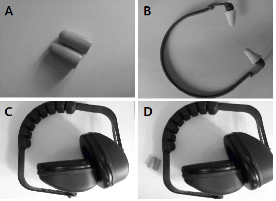
To obtain the bone conduction threshold using a Radio Ear B71 oscillator and a GSI 61 (Grason-Stadler, MN, USA) audiometer, the participant wore a protection device against exposure to 75 dB SPL white noise through a speaker. Hearing protection methods included ear form (3M ear plugs cordless), ear plug (3M caboflex band style), ear muff (EAR 5000C), ear form and muff together (Fig. 2). Also, four noise directions, i.e., 0(front), 90(left), 180(back), and 270(right) degrees, selected from a directional speaker system in a double-walled sound- treated booth, were tested. The order of the protection methods tested was ear form first, ear form and muff together, ear muff only, and finally, ear plug. However, the order of noise direction was randomized across the participants to eliminate any possible expectation.
III. Results and Discussion
3.1 Effects of sensitive placement at noise condition
To determine the most sensitive placement on the head for speech perception, a repeated-measures analysis of variance (ANOVA)1) (SPSS ver. 20, IBM ) was performed to compare thresholds obtained from 20 participants at 5 oscillator placement locations. Huynh-Feldt epsilon- adjustments for repeated measures were made when appropriate. Bonferroni correction was performed for significant main effects and interactions. The criterion for statistical significance was p<0.05.
A significant main effect emerged for oscillator placement location [F (4, 72) = 63.389, p< 0.00]. Thresholds obtained with condyle placement (mean = 13.453 standard error = .990) were lower than for the other placements. Although the mastoid placement showed the next lowest thresholds (mean = 14.700; standard error = .929), it did not indicate a statistically significant difference from thresholds obtained from the condyle. In addition, temple (mean = 21.087; standard error = .560), jaw angle (mean = 23.003; standard error = 1.240), and vertex (mean = 26.012; standard error = 0.688) placements followed as the placements with next-lower thresholds. There was no significant difference between jaw angle and vertex.
Our results showed that the most sensitive placement of the five skull locations was condyle, which was supported by McBride et al.[8] They reported that condyle had the lowest mean threshold of 11 locations. Unlike our results, which had the same order of the sensitive placements in either quiet or noisy conditions, McBride et al.[8] reported that the rank order of 11 skull locations differed slightly between quiet and white noise conditions. We assume the reason for this is that their study used tones having several frequencies ranging from 250 to 8,000 Hz, whereas our study used Korean spondee words.
3.2 Comparison of sensitivity at quiet to noise condition
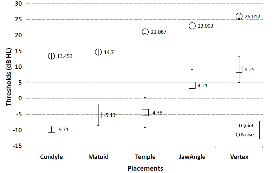
The previous data, which was measured at quiet conditions,[13] was compared to current data under noisy conditions (Fig. 3). The order of sensitivity was the same under quiet and noisy conditions. Condyle was the most sensitive placement under both conditions. However, the temple was less affected by noise, compared to the other placements. The thresholds of temple and condyle showed the greatest difference between quiet and noise as 25.467 dB and 23.163 dB respectively, while the jaw angle placement showed an 18.793 -dB difference. That is, the jaw angle was less sensitive in quiet-to-noise difference. The standard deviation of mean threshold in quiet was greater than that under noise conditions, which means there was larger individual variability to perceive the speech stimuli in the quiet situation than noise condition although the subjects have normal hearing.
|
Fig. 3. Bone conduction threshold along five placements in white noise, compared to quiet conditions. Error bars mean standard deviation. |
We found that the lowest threshold mean occurred when using ear form and muff together, which means that this dual protection method is the most effective either to communicate through the condyle pathway or to protect the air conduction pathway covered by pinna and ear canal. Although the amount of attenuation obtained from our hearing protection methods during 75 dB white noise exposure was not measured, dependence on the labeled attenuation rating on each of the hearing protection devices we used was not similar to our results. Neitzel & Seixas (2005) pointed out that there is often significant variability between the noise reduction rating (NRR) typically marked for the hearing protection devices in the United States and direct field attenuation measurement.[15]
3.3 Effects of protection methods
To gauge the effects of the protection methods, a repeated-measures ANOVA was performed to compare the thresholds obtained. A significant main effect occurred for the four protection methods used [F (3, 54) = 102.129, p< 0.00]. The thresholds obtained with a dual protection method, i.e., the ear form and muff together condition (mean = 11.340; standard error = .628) were the lowest when compared to the other conditions. Thresholds for the ear plug (mean = 20.120; standard error = 1.286), the ear form (mean = 21.205; standard error = 0.826), and the ear muff (mean = 25.940; standard error = .470) conditions showed less sensitivity to noise. Given the ranking of the protection methods, the post-hoc test was performed and indicated no statistical difference between ear plug and ear form, yet both were significantly lower than ear muff.
3.4 Effects of noise directions
A repeated-measures ANOVA was also performed to determine the effect of noise directions. There were significant differences among the four noise directions [F (3, 54) = 73.548, p< 0.00]. The thresholds obtained at 90 degrees (mean = 18.085; standard error = .666) were the lowest compared to the other conditions, whereas the thresholds of 270 degrees (mean = 21.450; standard error = .673) were the highest. Zero-degree and 180-degree conditions were 19.443 dB and 19.628 dB, respectively, in terms of mean values, but there was no significant difference between the two conditions.
Fig. 4 graphically depicted speech perception sensitivity of five oscillator placements when displaying four protection methods on the x-axis at four noise directional conditions at each panel. Based on mean thresholds across all four noise directions, the condyle was the most sensitive placement for perceiving speech when wearing the dual protection method, i.e., ear form and muff together. On the other hand, when the participant wore the muff only, the threshold of the vertex showed the highest values in any noise direction. In addition, no significant difference emerged in thresholds obtained from male and female participants [F (1, 18) = 5.150, p = .036].
IV. Conclusions and Suggestion
Most studies on auditory perception have focused on the conduction of sound through air, and thus have overlooked the alternative acoustic pathway of bone conduction.[9] Although hearing via bone conduction occurs naturally in listening to one’s own voice and to loud external sound,[16] sound can also be directly transmitted through the bone via vibrators attached to the skull, thus allowing the ear canal to be used for a protection device against noise.
The present study was designed to estimate the most sensitive placement of the skull to perceive speech through the bone vibrator in various protection methods while being exposed to noise. The results of this study indicate that the condyle is the most sensitive placement for the bone conduction pathway while wearing the dual protection method (i.e., an ear form plus ear muff condition). This may be the best communicative condition via the condyle bone conduction and dual protections of the air conduction under any noise direction. In order to assess the feasibility of this condition under actual working conditions, additional studies should be conducted.
There were no specific limitations of the present study. However, further studies should be conducted. First, workers with NIHL should be tested and then compared to normal-hearing subjects. Although Park et al. (2010) reported no difference in speech perception between protected and unprotected conditions in NIHL, they only considered the air conduction pathway while conducting the experiment.[5] We expect that there would be many differences in speech perception depending on stimuli routs, like our results for the normal-hearing subjects. Second, both normal-hearing individuals and workers with NIHL should be tested against various types of background noise (e.g., metal presses, pneumatic drills, turbines, and so on) present in the actual working areas. In the study by Park et al.,[5] the speech perception ability of NIHL when using white noise as the background noise was lower than when using other noise types. If we stimulate bone conduction, their speech perception ability would be altered. According to Griffin et al.’s survey study,[17] workers in the steady noise environment self-reported the use of hearing protection more accurately than workers in variable noise environments. Third, almost all bone conduction studies have been conducted over the past 40 years, so the results have been limited to audiology applications, such as using a bone conduction device to measure the hearing threshold in order to differentiate middle-ear disorders from inner-ear disorders. However, bone conduction hearing is a much more complex and less understood process than that of air conduction.[18] Thus we need to understand bone conduction auditory feedback including the occlusion effect of protection devices. In addition, future studies should also focus on more basic research conducted on bone conduction interfaces to identify effective locations of bone conduction vibrators and to ensure that their use does not impede the safety and survivability of military personnel. Finally, we need to consider continuous speech for everyday listening situations at the supra-threshold level instead of spondee words. Beattie & Smiarowski (1981) found that when sixteen subjects with normal hearing were tested at sensation levels ranging from 0 to 34 dB, the intelligibility scores ranged from about 15 % at 0 dB SL (sensation level) to 95 % at 34 dB SL.[19] Moreover, voice type such as male or female and background noise levels should be considered in future studies.[18]
Since chronic NIHL is most commonly caused by prolonged exposure to high levels of noise, to prevent manufacturing and construction workers from developing NIHL,[17] effective hearing protection devices and communicating though bone conduction must be used.