

I. Introduction
II. An Early History of the Velocity of Sound
III. Goldingham’s Measurement of the Velocity of Sound
IV. Conclusion
I. Introduction
In the early nineteenth century, the velocity of sound was a major physical quantity which was expected to measure by accurate instruments. In the late eighteenth and the early nineteenth centuries, new observational instruments were developed, and measuring activities were accorded very essential in physics. Measuring various quantities as precisely as possible was regarded as deepening the understanding of nature, and thus developing more accurate measur-ing devices was an advancement in experimentation. As one of the activities of measuring culture, trig-onometrical surveys were extensively performed for cartographic and geodetic purposes.
Measuring the velocity of sound proceeded on the basis of the development of the measuring skills in length and time. While the discrepancies between theoretically derived and experimentally measured values urged more controlled measurement of the velocity of sound, the British astronomer John Goldingham (1767-1849), who had been an expert in precise measurement, successfully undertook a great project of revealing the influences of various atmo-spheric conditions on the elusive physical quantity. His success was supported by a variety of resources: reliable weighing devices, a grand surveying project, institutional support of the observatory, and social reputation from the experience of astronomical inves-tigations. In this paper, these resources for success in experiment will be examined in detail in the case of Goldingham’s measurement of the velocity of sound.
II. An Early History of the Velocity of Sound
The idea that the speed of sound is definite began to occur to researchers from the ancient times. Aristotle claimed that the high note moved faster than low one. A criticism to this assertion came from his student Theophrastus. He conjectured rightly that when a sound of music from a distance arrives, one hears the same tune because the velocity of the sound is the same, whether its note is high or low [1].
Earnest efforts to determine the velocity of sound started in the seventeenth century. In 1635, Pierre Gassendi measured the velocity of sound in air [2]. Assuming the velocity of light is infinite, he mea-sured the time interval between the arrivals of the sound and the flash of a cannon over a distance. The measured value was 1,473 Paris feet/s (478.4 m/s), much greater than the real value. Later Marin Mersenne modified it to 1,380 Paris feet/s (448.2 m/s). In 1656 (or 1660), Italian Giovanni Alfonso Borelli and Vincenzo Viviani obtained 1077 Paris feet/s (349.8 m/s) [3]. These measured values were obtained without the consideration of temperature, humidity, velocity of wind. In 1738, the Academy of Sciences of Paris performed very exact measurement of the velocity of sound. The measurement converted to zero degree Celsius was 332 m/s, which was not different from those reliable data which were obtained in the nineteenth century by several meters per second [4].
In the early eighteenth century, various factors affect-ing the velocity of sound began to be considered. In 1708, Reverend William Derham decided rightly that the velocity of sound increases if the sound travels in the same direction as the wind blows and it decreases if the sound against the wind’s direction. He judged that the velocity of sound decreased in rain or fog but it was refuted by John Tyndall after 150 years. Derham hastily judged without measurement that the velocity of sound in summer was the same as that in winter. By 1740, Gian-Lodovico Bianconi who was a pro-fessor of medicine at Bologna University noted that the speed of sound in air increases with temperature [5].
Theoretical presumption of the velocity of sound started with Isaac Newton. The 50th proposition in volume 2 of Principia says that the gravitational acceleration multiplied by the thickness of the atmo-sphere which was assumed homogeneous was the square of the velocity of sound in air. Its conversion tells that the velocity of sound in air is  (
( : atmospheric pressure,
  : atmospheric density). From this, he put out the first guess of the velocity of sound in the air [6]. Newton recognized that his derived value was greater than what Derham measured by one sixth, but he did not discuss it any longer.
This recognition of the difference between the experimental and theoretical values prompted various investigations of the cause of discrepancy. Among them the most celebrated and currently accepted explan-ation was presented by Pierre-Simon Laplace. He suggested that the square root of the ratio of the specific heat at constant pressure to that at constant volume should be multiplied to Newton’s derived value on the ground that the change of the state of the bulk of air during the passage of the sound wave is an adiabatic process, not an isothermal process, since the recurrence of the compression and rarefaction of air is so rapid that the conduction of heat may not occur [7]. Efforts to obtain this value by measuring the two kinds of specific heats were made by F. de la Roche and J. E. Bérard, obtaining 1.4954 whose square root was 1.223. So the new presumption of the velocity of sound was 22.3 % greater than Newton’s derivation. In 1819, Nicolas Clément and Charles Desormes obtained 1.35 as the ratio of specific heat, which was adapted in Laplace’s Mécanique céleste in 1825. In 1822, Joseph Louis Gay-Lussac (1778-1850) and J.J. Welter obtained 1.3748 and reduced the discrepancy between the theoretical and experimental values [8].
III. Goldingham’s Measurement of the Velocity of Sound
In the early nineteenth century, there were efforts to obtain more accurate measurement of the velocity of sound in air. Among them, the measurement of John Goldingham (1767-1849) is worth noting because it was the first measurement of the velocity of sound in air in various conditions which might affect the quantity. It attracted much interest in scientific circles. The report was published in the famous scientific journal Philosophical Transactions of the Royal Society of London in 1823 and mentioned repeatedly in many books, journals, and encyclopedias [9].
At that time, although Laplace’s modified theory of the velocity of sound was presented, it was widely recognized that the theory was not enough explan-ation of the velocity. In addition, whether the dis-crepancies which had been found among measure-ments originated from the experimental errors or other factors which came in measurement was not yet decided. Goldingham was the first one who attempted to analyze various factors affecting the velocity of sound through a good many measurements. He arranged in eleven tables the results of daily practices of measurement performed from the second half of 1820 to the next year. There was no one who had ever measured the velocity of sound so many times through so long period. He recorded temperature, atmospheric pressure, humidity, wind intensity, and wind direction when-ever he measured the velocity of sound.
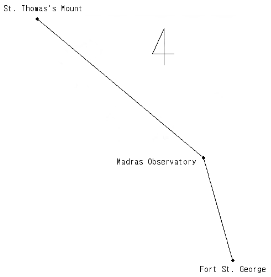
The fact that various conditions of air affected the velocity was well known at that time, but there were two kinds of obstacles for access to those factors in experimental settings: the acquisition of measuring instruments for quantifying those factors, and the control of the conditions of air for experiment. As for the former obstacle, the official astronomer Goldingham easily acquired support from the government to buy those weighing instruments like thermometers, bar-ometers, and hygrometers. He had been appointed as the first official astronomer of Madras Observatory in 1802. In the same year, he denoted the Madras Time which was to be the basis of Indian Standard Time. He was at a legitimate position to get better measuring instruments. As for the latter, he could not change the conditions of all the air through the path of the pro-pagation of the sound from the cannon when he employed the traditional method for measuring the velocity of sound, that is, the timing of the difference between the flash and the sound of a cannon. Goldingham solved this problem by utilizing the natural change of conditions of air; to take different air samples, he repeated the daily measuring acts all through the year. In this region, temperature, atmos-pheric pressure, humidity and wind direction changed daily. Through monsoon seasons, the air conditions showed gradual and typical change. To detect the effect of the wind direction on the velocity, he took two different paths of the sound, one coming from a cannon at St. Thomas’s Mount and the other coming from a cannon at Fort St. George. The sound in the first path traveled from NW to SE, and that in the second path from SE to NW. Two sound sources and the station of observation were not in a straight line, and the first sound source was almost twice as far as the second from the station. (Fig. 1) This deliberate arrangement magnified the differential effect of the wind direction on the velocity of sound.
To accomplish successful measurement of any physical quantities, Goldingham had to secure the precision of the results, which could be guaranteed by trustworthy practices in measurement. Weighing quantities was an important scientific practice in the late eighteenth and the early nineteenth centuries. France was leading in surveying the lands and measur-ing all kinds of physical quantities which were pursued as national projects. The meter system had been promulgated through the same intellectual enterprises. In Britain there was common recognition that they should survey all the country by tri-angulation for precise maps. This desire was being realized in South Asia as Great Trigonometrical Survey of India, started by Colonel William Lambton [10]. Lambton’s important data made Go ldingham successful in his measuring the speed of sound.
|
Fig. 1The Relative Positions of the Madras Obser-vatory, St. Thomas’s Mount, and Fort St. George. |
Goldingham had tried to measure the velocity of sound between 1793 and 1796, he prepared a pocket chronometer made by John Arnold, which was one of the most accurate timekeepers which were com-mercialized at that time. This chronometer ticked 5 times in two seconds, providing the accuracy of 0.4 seconds. However, Goldingham could not produce satisfactory results since he did not know the exact distance between two points. Then Lambton’s Great Trigonometrical Survey measured a base at St. Thomas’s Mount, near Madras in 1802, and Goldingham obtained reliable standards.
To obtain the distance between two points, Goldingham measured the length of the base twice and measured the angles between the line from each end of the base to the object and the baseline 6 times using the grand circular instrument, which had been used on the Great Trigonometrical Survey. Then he compared his results with what Lambton obtained. The distance between the observatory and the gun on the Mount was determined to be 29,547 feet after 12 trials and the distance between the observatory and the gun on the fort 13932.3 feet after 6 trials. Goldingham presented a map made by the surveying engineers under the supervision of his son-in-law E Lake. This map shows the positions of the guns and the observatory, and the surface condition under the course of the sound trans-mission. This reflects his consideration of the geo-graphical factors which might affect the speed of sound.
Under the background of the pervasiveness of the spirit of precision in scientific circles, Goldingham’s trustworthiness in measuring the speed of sound was benefitted by his fame as a measuring expert in as-tronomy. As the astronomer of the Madras Observatory, Goldingham made an exact measurement of the length of the seconds pendulum at Madras, which was 39.026302 inches of Sir George Shuckburgh’s scale, at the temperature of 70° in vacuo, and at the level of the sea. By comparing this result with the length of the pendulum vibrating seconds in London, he arrived at a new value of the ellipticity of the earth, which had been a hot issue in scientific circles [11]. And he also made some exact measurements of longitudes of some places by both methods in use at that time;
The longitude of Masulipatam Flagstaff by the eclipses is 81° 12′33″, and by the chron-ometer 81° 12′15″, which is so close an agreement, that the longitude of this important point of the coast may be regarded as correctly determined [12].
His measuring practices in astronomy already secured trustworthiness, which guaranteed reliability in his measuring activities in other fields such as the measurement of the speed of sound. His observation of the velocity of sound was praised by other scientists as well-conducted and valuable.
Another factor for success in Goldingham’s big project was institutional support. The enhancement of reliability in Goldingham’s measurement was enabled by the observation of 808 cannon reports for one and a half years. He kept 520 observation records of the sounds from St. Thomas’s Mount from July, 1820 to November, 1821 and 288 observation records of the sounds from Fort St. George, from July, 1820 to March, 1821 [13]. (Fig. 2) These constant practices were enabled by the support of the Madras Army. At the same time every day, the cannons were fired, which was hard-to-get but optimal regularity for precise observations. This arrangement was provided by the local government which supported the Madras Observatory of which Goldingham was in charge. His status as the official astronomer was beneficial for all the experimental settings.
|
Fig. 2. Part of Goldingham’s Records of the Measurement of the Velocity of Sound. |
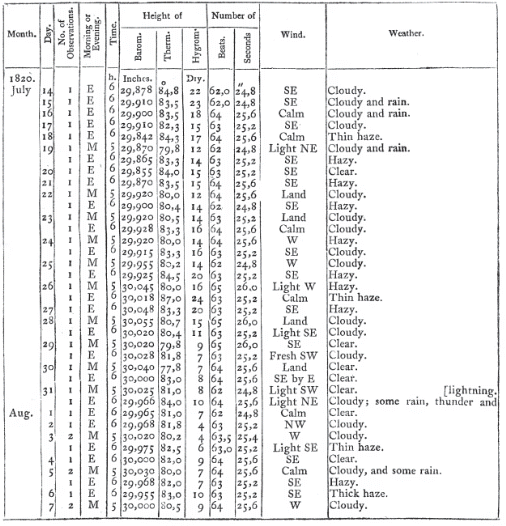
Goldingham observed the reports from St. Thomas’s Mount which was separated from the Madras Obser-vatory by 29,547 feet (8.95 km) toward Northwest and from Fort St. George which was separated from the observatory by 13932.3 feet (4.22 km). At Fort St. George, the cannon was fired in daylight in the morning and at eight o’clock in the evening. At. St. Thomas’s Mount, the cannon was fired in daylight in the morning and after sunset in the evening. By the positive cooperation of the Army, the guns continued to be used as sound sources. The cannons were 24-pounders, which were fired toward the observers by the gunpowder of 8 pounds (3.6 kg). Fort St. George, 120 feet (36 meters) above sea level, was located to NE of the observatory, while St. Thomas’s Mount, 30 feet (9.0 meters) above sea level, was located to SW of the observatory. All the measure-ments of time intervals were performed by Arnold’s chronometers. In general, two Indian Brahmin assistants performed the measurements, although Goldingham himself some-times took part in it. Carrying his own chronometer, each assistant counted the ticks until catching the report after seeing the flash of the cannon firing. Without discussing, they came to Goldingham and reported the results, and Goldingham recorded the conditions of air, that is, temperature, atmospheric pressure, humidity, weather, wind direction [14].
Goldingham noted the effect of the conditions of the atmosphere on the speed of sound. He recognized the great variance of the time of transmission of sound from the Mount to the observatory, ranging from 27.6 seconds to 24.8 seconds. He explained that when the temperature rises, the density of the atmosphere goes down and its modulus of elasticity rises, and then the rise of the velocity occurs.
From the analysis of the records, Goldingham concluded that the rise of 1 ℉ (0.56 ℃) led to the rise of 1.2 ft/s (0.36 m/s) of the velocity, the rise of 1 degree in humidity allowed that of 1.4 ft/s (0.42 m/s), the rise of 0.1 inch in atmospheric pressure led to that of 9.2 ft/s (2.8 m/s) in the velocity and that a modest wind caused the rise of the velocity by 10 ft/s (3 m/s), differentiating the velocity by 21.25 ft/s when the sound went along the wind and when the sound went against it [15].
IV. Conclusion
In the early nineteenth century, it came to be well- known that there were many factors to affect the velocity of sound. But there was no determination of trustworthy quantitative relation of each factor to the velocity, because there were many obstacles to cope with in establishing the relations by experiment. It was Goldingham who made measurements of the velocity of sound in various conditions of air and established the first quantitative relations between the velocity and those meteorological elements.
Goldingham’s success in this experimental achieve-ment originated from a well-woven web of material, institutional and social resources. As he took the traditional method of measuring the distance between two points and the time spent during the travel of a sound between the two points, he had to know the exact distance of the two stations. Fortunately, in India, the trigonometric surveys were pursued for making accurate maps and measuring the length of the arc of one degree. Although the triangulation at Madras was already undertaken by the initiative of Colonel Lambton, Goldingham hired surveyors to measure the distances between the observing spot and the sound sources. In addition, since the observers had to measure the exact time between seeing the flash and hearing the report, Goldingham employed Arnold’s chronometers which were widely being used.
On these material bases for accurate measuring, Goldingham made use of institutional resources to carry out hundreds of times of measurement for more than one year under various weather conditions. As the official astronomer of the Madras Observatory, he was being supported to do various official activities of observing the astronomical phenomena. In this activities, he easily acquired many instruments for measuring the conditions of air. Above all, he obtained a stable set of sound sources which would work regularly according to the experimental setting. The Madras Army provided the official astronomer with its regular artillery practices which included daily firing of two cannons at two different locations for more than one year.
As for his successful scientific enterprise, Goldingham’s reputation as a measuring expert enhanced the reliability of his report of measurements. Though acoustics was not his main field, he was already a famous astronomer who made successful measure-ments of various quantities and published the reports in famous scientific journals. The acceptance of the accuracy of his measurements was confirmed by his skillfulness of treating scientific instruments and setting them up for specific purposes.