


I. Introduction
II. Methods
2.1 Sites
2.2 Measurement procedure
2.3 Data analysis
2.4 Evaluation of acoustic environment
III. Results
IV. Discussion
V. Conclusions
I. Introduction
A number of studies have investigated Indoor Environment Quality (IEQ) and occupants’ comfort in various kinds of buildings.[1,2] It has widely been known that a better IEQ substantially results in benefits for occupants’ health and well-being. IEQ has four key attributes, namely thermal comfort, indoor air quality, lighting comfort, and acoustic comfort. Each of the four attributes has crucial impacts on occupants’ performance and well-being.[3,4]
Recently, a growing number of studies have tried utilizing indoor environment monitoring sensors for measuring the IEQ.[5,6] Although using such sensors may be less accurate than standardized measurement methods, it is advantageous since it monitors each environmental quality level in the long term. Moreover, it is quick and easy to approach the monitored data if the data are stored online. Due to the fast development of smart building technologies, the demand for adopting such methods is gradually increasing.
The present study is involved in a project aiming to assess the IEQ of public buildings in Korea. Particularly, the study focused on indoor acoustic environments. Noise has adverse effects on human health and well-being,[7] and poor acoustic environments in office spaces have been acknowledged to reduce employees’ performance and satisfaction.[8,9]
The study sampled public buildings in Korea and measured indoor noise levels. There are a few standards providing recommendations on indoor noise levels. As shown in Table 1, the International Organization for Standardization (ISO) classifies six space types depending on the characteristics of activities and suggests recommended noise levels.[10] The European standard suggests ambient noise levels for the different purposes of space usage, and those for landscaped offices were between 35 dBA and 45 dBA.[11] The British standard proposes ranges of indoor ambient noise levels when the spaces are unoccupied and privacy is important - it has been recommended that the design range of indoor ambient noise levels in open-plan offices is between 45 dBA and 50 dBA.[12] and Also, the American Society of Heating, Refrigerating and Air- Conditioning Engineers (ASHRAE) has developed Noise Criteria (NC) curves for specifying acceptable indoor noise levels.[13] Recommended NC curves for open-plan offices are NC-35 and NC-40, which are equivalent to 45 dBA ~ 50 dBA. Furthermore, there are tools for assessing acoustic comfort of indoor environments such as the TAIL indices developed by the European Union’s ALliance for Deep RENovation in Buildings (ALDREN) project.[14] Its recommendations for indoor noise level are shown in Table 2. Based on the existing recommendations, this study examined the acoustic environments in the sampled public buildings.
Table 1.
The ISO recommendations for indoor noise levels in open-plan offices (ISO 22955:2021).
Table 2.
The EU ALDREN recommendations for indoor noise levels in open-plan offices.
II. Methods
2.1 Sites
As presented in Table 3, a total of 13 sites with open-plan offices were sampled for the measurements. Seven of them were in Seoul, three in Goyang, two in Daejeon, and one in Gunsan. Buildings with seven sites were used for general public purposes, four were office spaces in community centers, and two were located in research institutes. Five of them were located in the areas which were mainly residential areas while the other eight were in industrial areas. Three measurements were conducted on the 1st floor of the building and two were done on relatively high floors, on the 11th and 9th floors (Sites 1 and 5), respectively. Six sites were located on the top floor of the buildings. The study also considered the distance from major roads which had more than four lanes. Distance from the major road ranged from 21 m to 210 m (Sites 6 and 3), respectively. The number of the lanes ranged from four to ten. The ages of the buildings were computed with the year of completion of each building. The ages of the buildings varied, ranging from 9 to 55 years (Sites 7 and 2), respectively. It was unknown whether each building, particularly the exterior of each building, has been undergone any refurbishment.
Table 3.
Sample sites where the indoor noise measurements were carried out.
| No. | City |
Purpose of the building | Area typea | Floorb |
Distance from the major road (m) |
Number of lanes of the major road |
Age of the building (years) |
| 1 | Seoul |
General public sector | I | 11/15 | 80 | 6 | 47 |
| 2 | R | 2/5 | 198 | 6 | 55 | ||
| 3 | R | 3/3 | 210 | 10 | 27 | ||
| 4 | R | 1/4 | 145 | 10 | 36 | ||
| 5 | Goyang | I | 9/10 | 52 | 8 | 26 | |
| 6 | I | 3/3 | 21 | 4 | 32 | ||
| 7 | Gunsan | I | 2/8 | 45 | 4 | 9 | |
| 8 | Seoul |
Community center | I | 1/3 | 30 | 4 | 52 |
| 9 | R | 2/2 | 110 | 4 | 34 | ||
| 10 | I | 1/4 | 85 | 4 | 31 | ||
| 11 | Daejeon | R | 3/3 | 115 | 7 | 30 | |
| 12 | Goyang |
Research institute | I | 2/2 | 170 | 10 | 11 |
| 13 | Daejeon | I | 2/2 | 90 | 7 | 43 |
2.2 Measurement procedure
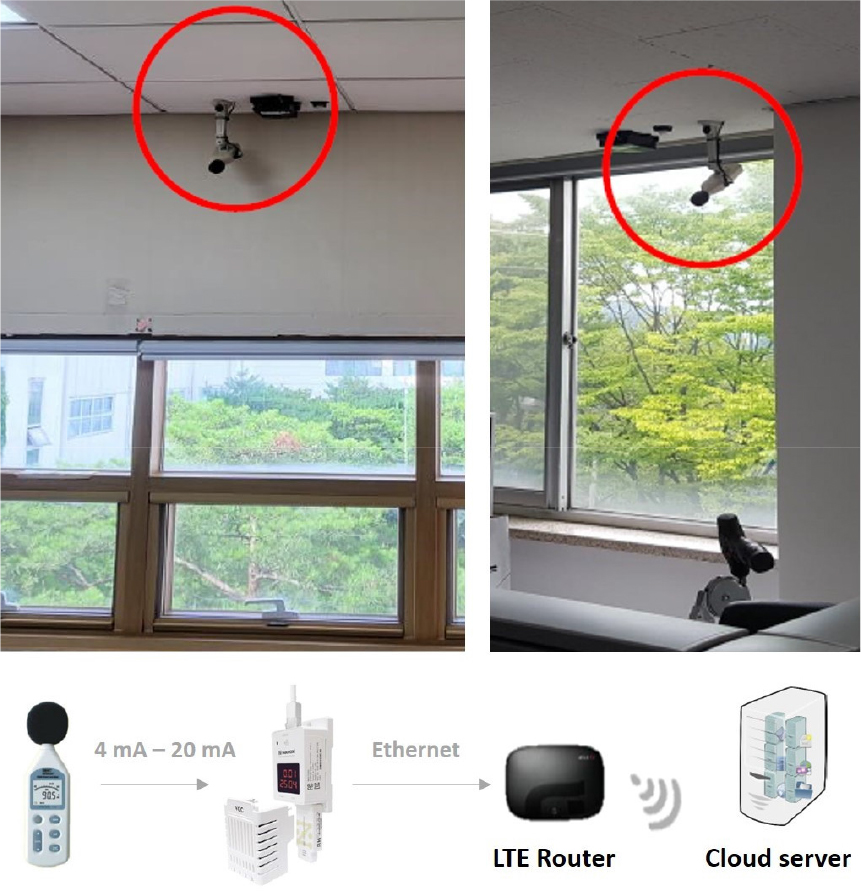
One sound level meter (AR824, Smart Sensor®) and a transmitter (RN171, Radionode) were set for measuring indoor noise levels at each site. Each sound level meter used a 1/2-inch condenser microphone. The measurement interval was 2 minutes. The measured data were transmitted via the transmitter and stored on the server. For safety reasons, the sound level meter, the transmitter, and the router were installed where occupants were not likely to reach (Fig. 1).
2.3 Data analysis
This study analyzed sound pressure levels (dBA) measured for five consecutive working days from October 17th Monday to 21st Friday, 2022. Although occupants in different buildings might have had varied working hours, the study chose the time period between 9 am and 6 pm as working hours and looked into this time frame in more detail. LAeq,working-hours have been computed with the data measured for the working hours for each day. In addition, LAeq,night-time has been derived with the data measured between 11 pm and 12 am on the same days in order to assess the acoustic environment in an unoccupied condition. The statistical tests were performed using jamovi (v. 2.3).[15,16,17]
2.4 Evaluation of acoustic environment
Target noise levels suggested by the ISO 22955:2021[10] were used for assessing the LAeq,working-hours (Table 1). Although the present study used sound monitoring sensors and it was not in line with the methods that the ISO has stated, its recommended levels were adopted to evaluate the acoustic environments of the sites. This standard was chosen since it is for evaluating indoor noise levels of open-plan offices in an occupied condition. It recommends upper limit values of noise level for different types of space. To evaluate the acoustic environments measured at each site, the present study adopted a recommended value of 52 dB for Space type 3. In this type of space, activities are expected to be mainly based on collaboration between people at the nearest workstation. This target value is for securing good intelligibility at workstations when occupants speak normally without raising their voices.[10]
Moreover, the ALDREN recommendation[14]was adopted for evaluating the LAeq,night-time measured in an unoccupied condition (Table 2). It classifies four categories depending on the expected level of indoor environments. The present study adopted the upper limit level of 45 dBA which is proposed as a moderate level of expectation (Category 3).
III. Results
As presented in Table 4, LAeq,working-hours ranged from 42.5 dBA to 59.0 dBA. The lowest was from Site 13 on Friday while the highest level was found from Site 1 on Wednesday. There were six sites which showed indoor noise levels not meeting the ISO recommendation at least for one day. Particularly, LAeq,working-hours measured at Site 6 exceeded the recommendation for four days. In addition, LAeq,night-time ranged from 34.0 dBA to 51.2 dBA (Table 5). The lowest level was measured at Site 13 on Wednesday and Thursday. The highest level was from Site 6 on Friday. Three sites (Sites 5, 6, and 11) consistently presented higher noise levels than the recommendation. Since the high background noise levels at these sites may be due to various reasons, the study excluded these data from the following statistical analyses.
Table 4.
Noise levels measured from each site when occupied during working hours; those exceeding the recommendations are presented in bold and in red cells.
Table 5.
Noise levels measured from each site when unoccupied at night-time; those exceeding the recommendations are presented in bold and in red cells.
Shapiro-Wilk tests showed that the indoor noise levels did not meet the normal distribution. Thus, non-parametric tests were conducted for further analyses. First, the paired Wilcoxon signed rank test was performed and there was no significant difference between the days (e.g., Monday vs. Tuesday). Second, the one-way analysis of variance (ANOVA) on ranks (Kruskal-Wallis H tests) was performed and found that the floor of the site did not change LAeq,working-hours [H (4) = 7.47, p = 0.113] while it significantly changed LAeq,night-time [H (4) = 17.24, p = 0.002]. Besides, significant differences were found in LAeq,working-hours [H (9) = 29.0, p < 0.001] and LAeq,night-time [H (9) = 49.0, p < 0.001] affected by the age of the building and the distance from major roads. The number of lanes in the road also had significant effects on LAeq,working-hours [H (3) = 12.2, p = 0.007] and LAeq,night-time [H (3) = 12.8, p = 0.005]. Third, Mann-Whitney U tests indicated that LAeq,working-hours was greater for the buildings used for the general public sector (Mdn = 47.8 dB) than the buildings for other purposes (Mdn = 46.8 dB), U = 201, p = 0.031. In addition, LAeq,night-time was higher for sites in the industrial area (Mdn = 40.3 dB) than those in the residential area (Mdn = 38.0 dB), U = 175, p = 0.013.
IV. Discussion
High indoor noise level is expected to have negative impacts on occupants. Particularly, in the case of office spaces, a poor indoor acoustic environment is likely to disturb occupants not just with their speech intelligibility but also with their work performance and job satisfaction.[8,9] The present study measured indoor noise levels at 13 open-plan offices in different public buildings in Korea. The indoor noise levels during the working hours met the ISO recommendation at most of the sites. It implies that occupants might have been in satisfactory acoustic environments in general. The study used the ISO target level of 52 dBA which was for Space type 3 where activities mainly based on collaboration between people at the nearest workstation are expected. This level secures good speech intelligibility at workstations when occupants speak normally without raising their voices.[10] However, there is still a need for an improvement in intelligibility at the workstations. Aiming for securing the target level of 48 dBA of Space type 4 where activities are expected to be mainly based on collaboration between people at the nearest workstations,[10] would be beneficial for occupants using and working in the space.
Furthermore, acoustic environments in an unoccupied condition were evaluated by the ALDREN recommendation. Three sites showed noise levels exceeding the recommendation. It might be either due to unidentified noise sources located indoors nearby the sound level meters or due to poor sound insulation of the building envelope. In the former case, it is believed that future studies would set the methods of data collection more carefully. The sound level meters should be located where noise from any devices would have no impact on the measurements. In the latter case, improvement in acoustic performance should be considered when planning the building renovation. Assuming that the age of the building may account for the acoustic performance of the building envelope, the study examined the effects of the age of the buildings on the indoor noise levels. The results showed significant differences in the noise levels affected by the age factor, implying potential effects of the acoustic performance of each building. However, it is unknown whether the buildings had undergone any refurbishment in the past and thus, further studies are needed on the relationship between the actual performance of the building envelope and the indoor noise levels. Besides, the present study adopted the recommended level of 45 dBA for Category 3 of ALDREN. It is recommended that a higher level of expectation (e.g., 40 dBA for Category 2) can be aimed when planning for building renovation for providing occupants with better acoustic comforts.
The study found that the floor level of the sites had a significant effect on the indoor noise levels at night-time. This may be due to increased outdoor wind noise exposed to higher floors. It implies that occupants on higher floors are more likely to be exposed to higher outdoor noise levels. Some previous studies have also reported such a tendency of increased outdoor noise levels on the higher floor[18,19] but there are still research needs for in-depth investigation to generalize the finding. Moreover, the study regarded the increased indoor noise levels during the working hours were due to the activities of the occupants because it showed similar tendencies over the five days for all sites. However, it is believed that there is a need for the identification of the noise sources for more accurate investigation. Future research may adopt research methods of noise source localization in order to identify what the noise sources are and where they are coming from.[20,21]
Additionally, the distance from the major road also showed significant effects on the indoor noise levels. In other words, the closer the sites were to the roads, the higher the noise levels were. The study also found that noise levels changed when the sites were grouped by the purpose of the building and the type of surrounding area. These results lead to future investigations on additional variables considering diverse factors related to the building and the surrounding area. Consideration of the indoor space itself is also needed. A suggestion can be made to look into the occupant density of the space. In order to compute the density, information about the average number of occupants in the space and the floor area (m2) of the space would be needed. Furthermore, a follow-up study can be conducted to examine the data obtained in different seasons, so that the effects of the noise events that the Heating, ventilating and Air Conditioning (HVAC) systems induce can be included.
The study used monitoring sensors. The data were useful to look into the acoustic environments at each site in the long term and to understand the methods for improving occupants’ comfort at each site. Nonetheless, there are still limitations in the methods. First, the present study did not obtain frequency characteristics. Given that it only measured sound pressure levels, there was a lack of in-depth data analyses. Second, the study performed one measurement for each site. It cannot be believed that the indoor noise levels measured by one device can represent the acoustic environment of the whole space. Depending on the size of the space, multiple microphones are recommended to be used for more accurate data collection. In addition, the devices were installed close to ceilings, walls, or windows where flanking noises can affect the measures. Given that the measurements were not performed in accordance with the standards, future research should carefully design the measurement procedure. Third, although the IEQ contains three other key attributes (i.e. thermal and lighting environments, and indoor air quality), the present study only focused on the acoustic environment. In order to improve occupants’ comfort in indoor environments, it is believed that a comprehensive study of all the IEQ attributes is needed. Lastly, this study did not collect any data on occupants. Future research may expand its scope to the effects of indoor environments on occupants. This would also involve measuring occupants’ various psychological and physiological responses.[22] Given that the ultimate goal of a better acoustic environment is for occupants who use the space, it is needed to probe how the level of individuals’ demands on the IEQ varies depending on the purpose of the space, job characteristics, and various other individual traits.
V. Conclusions
This study analyzed the measurements of indoor noise levels at 13 open-plan offices in Korean public buildings. The study analyzed the indoor noise measurements performed for five consecutive working days. The measurements were conducted in October 2022. LAeq,T values were calculated for working hours from 9 am to 6 pm and at night-time from 11 pm to 12 am. The study evaluated the acoustic environments of each site based on the target noise levels that the ISO and the EU ALDREN project have suggested. The results showed that most of the office spaces met the ISO standard during working hours. In addition, three sites did not meet the recommended level of the ALDREN when it was in unoccupied conditions at night-time. The results showed that the indoor noise levels were significantly affected by some features of the sites such as floor or distance from major roads. The manuscript concludes by making discussions on the findings, limitations of the study, and future research directions.