


I. Introduction
II. Theoretical background
2.1 Finite element method for acoustic- structure interaction
2.2 Acoustic property of bubble layers: Commander and Prosperetti
2.3 Simple approach: radiation efficiency prediction of structure with air bubble
III. Numerical examples
3.1 Numerical models
3.2 Numerical results
IV. Conclusion
I. Introduction
Air-bubble curtains are commonly used to reduce underwater noise levels. The interaction between radiated sound and air bubbles has been extensively studied in engineering applications. Wursig et al.[1] measured sound intensities near pile-driving in the sea and demonstrated the effectiveness of air-bubble curtains in reducing radiated noise. Park et al.[2] developed an analytic solution to examine the insertion loss of fluid-loaded plates with bubble layers, while Lee et al.[3] studied the behavior of elastic shell models surrounded by air-bubble layers.
We proposed simple approach to estimate the radiation efficiency for plate structures with air bubble in the previous study.[4] To validate the proposed method, it was compared with numerical analysis.
II. Theoretical background
2.1 Finite element method for acoustic- structure interaction
The inhomogeneous Helmholtz equation is commonly used in acoustics in the frequency domain for describing the propagation of sound waves in inhomogeneous media, including sources of sound, and takes the form:
where is the total acoustic pressure field () multiplied by the wave number () squared and divided by the fluid density (). This term represents the propagation of the sound waves in the fluid medium. The and are the monopole and diploe domain sources, respectively.
The acoustic-structure coupling includes both the fluid load acting on the structure and the structural acceleration caused by the fluid. The acoustic-boundaries condition, which describes the interaction between sound wave and surface in the acoustic medium, are expressed as:
is normal vector to the surface, and is the structural acceleration. is the force per unit area by the surface. The internal boundary condition expressed by:
and mean the acoustic pressure on the down and up sides of the interior boundary [shown in Fig. 1(a)].
2.2 Acoustic property of bubble layers: Commander and Prosperetti
According to Commander and Prosperetti,[5] the equivalent wave number of bubbly fluid provides the following relationship for a pressure wave with a time dependence proportional to:
The function represents the bubble distribution, and can be used to quantify the number of bubbles per unit volume, while is a radius of bubble. is the damping coefficient of the bubble and is the resonant frequency of the bubble. The damping coefficient of the mixed medium of bubble and water, , is expressed as the imaginary part of the equivalent wave number:
when the wave is propagated to a [m], the attenuation is equal to 8.686 [dB]. In this study, the bubble distribution was followed by a normal distribution.[3]
2.3 Simple approach: radiation efficiency prediction of structure with air bubble
Insertion loss is a measure of the reduction in sound power level (SPL) caused by an acoustic barrier, such as air bubble, wall, panel, and etc. It is expressed in decibels (dB) and is calculated as the difference between the sound power level of the source without the barrier (SPLI) and the sound power level of the source with the barrier (SPLII).
In a previous study,[2] it was demonstrated that the insertion loss is equal to the attenuation of the air bubble layer (). Therefore, the SPLII can be obtained by difference between SPLI and using Eq. (8).
SPLI was obtained from numerical analysis.
The acoustic radiation efficiency is defined as the sound power emitted by the vibrating structure, the mean square velocity in the entire area of the surface.
where is the density of the fluid, is the sound power emitted by the vibrating structure. is the mean square velocity in the entire area of the surface S. The simple approach was briefly summarized as follows:
1. Calculate the attenuation, which was assumed to be equivalent to the insertion loss caused by the transmission through the bubble layer.
2. Obtain the sound pressure level from Finite Element Analysis without including the bubble layer model.
3. SPLII is calculate by differences between SPLI and IL
It is possible to obtain insertion loss and radiation efficiency using fully coupled analysis, but it needs more time to generate Finite Element (FE) model and compute results. Therefore, we proposed a procedure of simple approach for reducing computing power.
III. Numerical examples
3.1 Numerical models
To validate proposed approach, the fully coupled analyses were performed for the fluid-loaded plate models with air bubble. As shown in Fig. 1(a) ~ (b), a two-dimensional axisymmetric acoustic-structure interaction analysis were carried out for two type plates: finite and infinite plates. A point load was applied at the center of the plate.
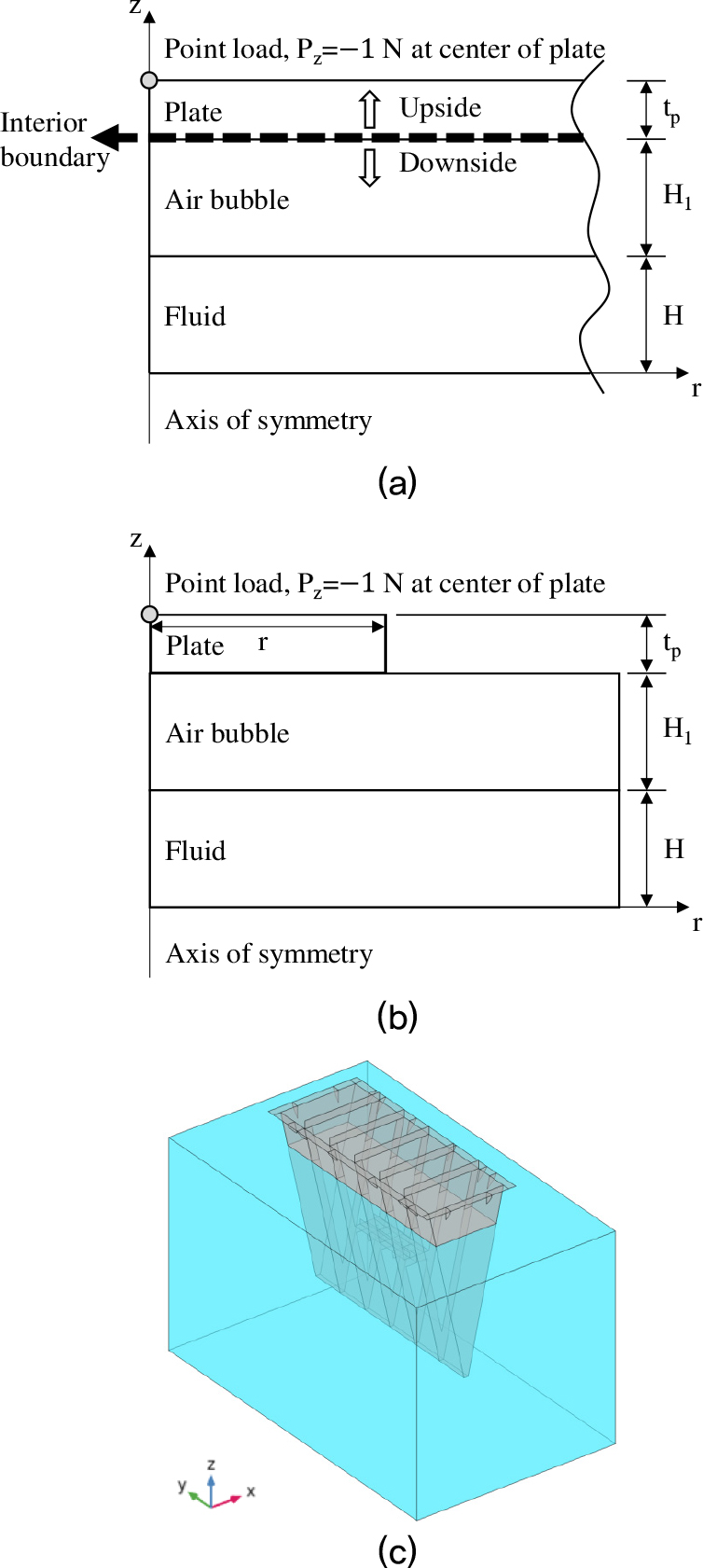
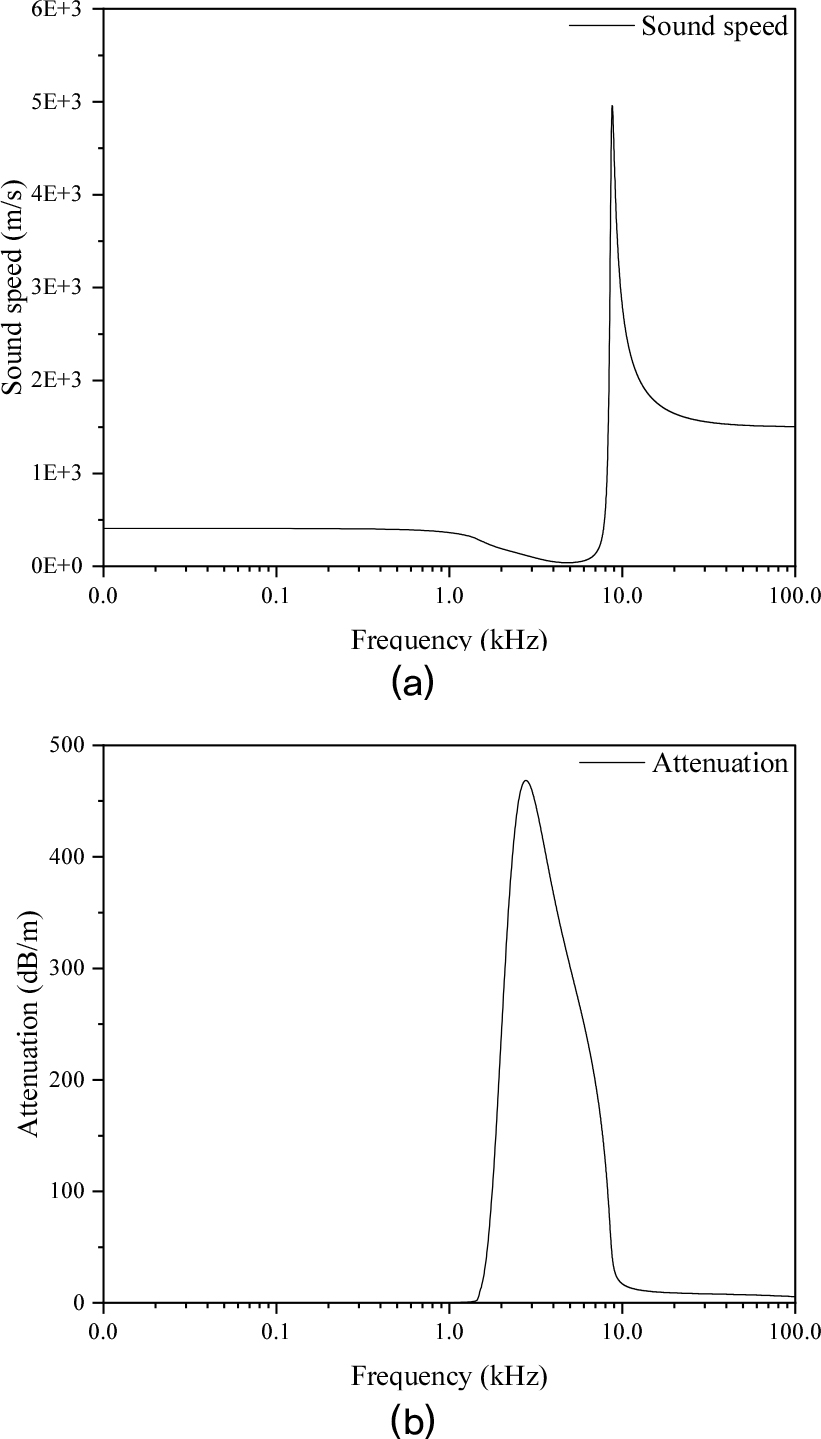
Furthermore, the simple approach was conducted to investigate the radiation efficiency characteristics of composite plate stricture, which was the wedge-shaped structure [see Fig. 1(c)]. The length, width, and height were defined by the , , and -directions. A unit load was applied to the inner stiffener. The parameters for numerical analysis are presented in Table 1. The Perfectly Matched Layer (PML) was added to the absorbing boundary to make the domain infinite. The convergence study was conducted to determine the appropriate element size, and one bending wave of the plate was discretized with eight elements. The acoustic property of the bubble layer was defined by the sound speed and attenuation coefficient (see Fig. 2).
Table 1.
Parameters for numerical models.
3.2 Numerical results
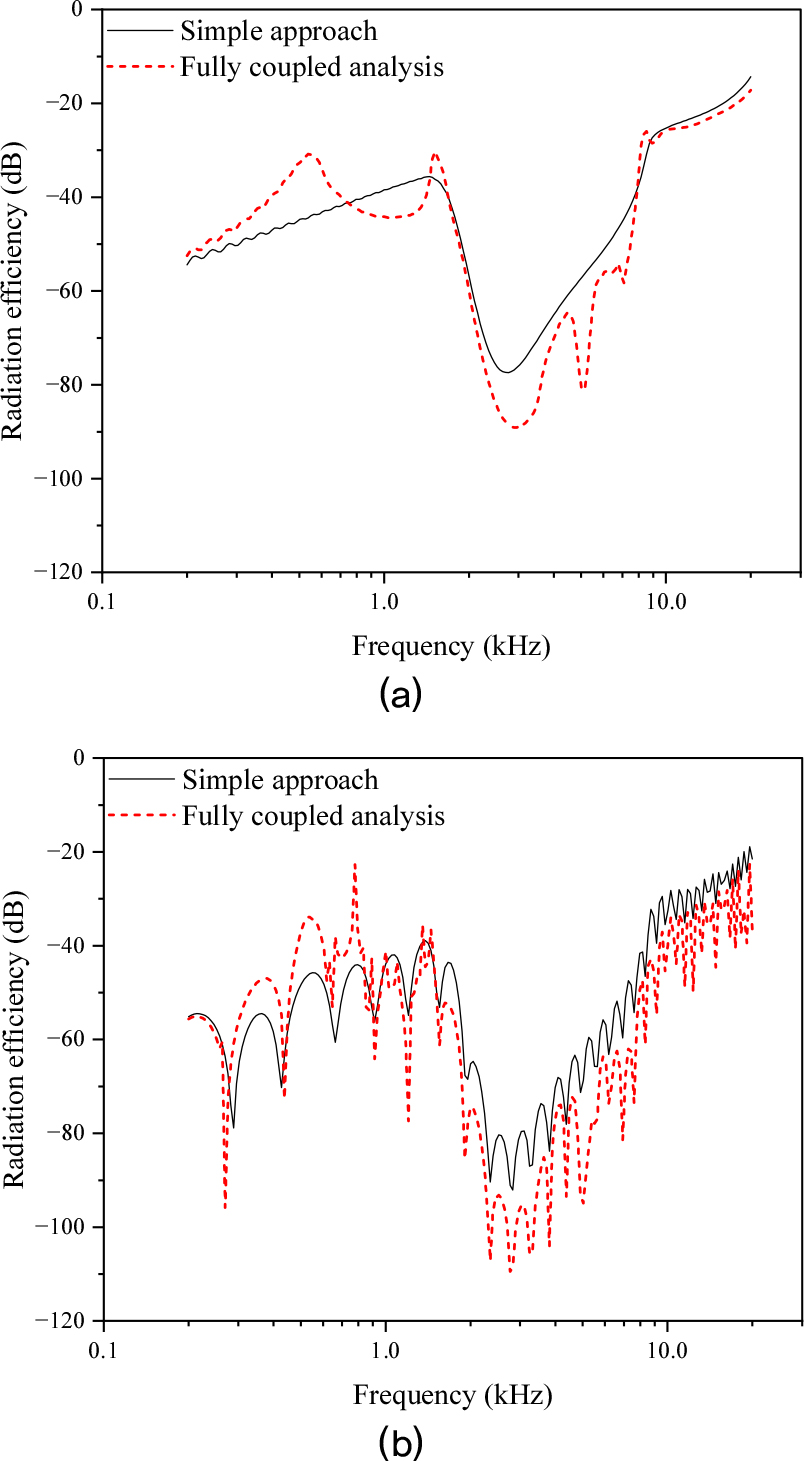
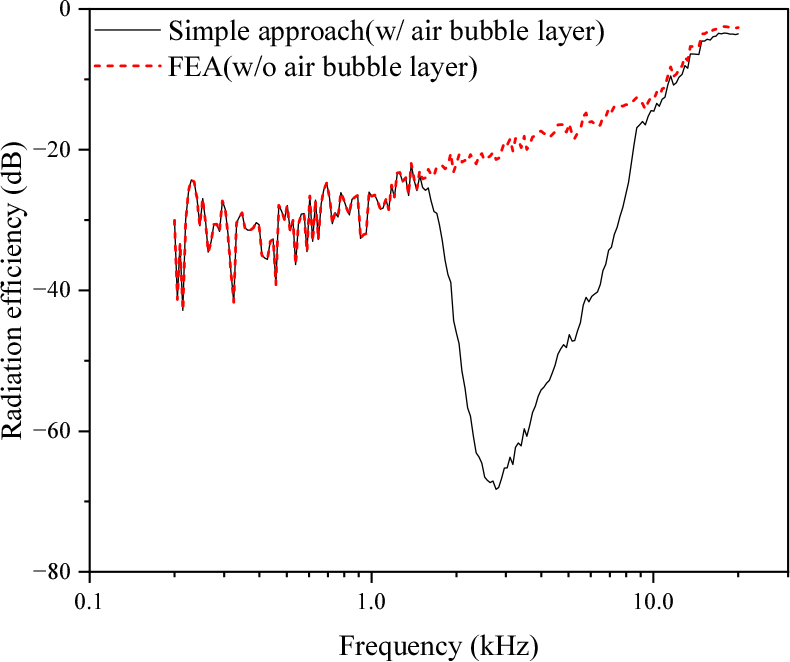
The radiation efficiency of plate models was compared between fully coupled analysis and simple approach from 200 Hz ~ 20,000 Hz, as presented in Fig. 3. The results indicate that, for finite plates, the simple approach underestimates the radiation efficiency above 1.5 kHz, which is the frequency range where the effect of a bubble layer begins to have an effect compared to the fully coupled analysis. In the fully coupled analysis, a rapid decrease in radiation efficiency was observed within a specific frequency range. Further studies are necessary to validate these results. Despite the differences between the two method, the trends in the results exhibit a relatively good match. The analysis for finite plates confirms that the characteristics of finite plates are accurately reflected in the results, which were compared based on peak values. Fig. 4 shows the radiation efficiency from simple approach compared with the numerical result without air bubble layer (w/o air bubble layer).
IV. Conclusion
This paper proposed a simple approach to investigate the radiation efficiency of a structure surrounded by an air bubble. The fluid-loaded plate models were selected to validate this method by comparing it to the fully coupled analysis results. The study shows that it is feasible to replace the insertion loss with attenuation.
In parallel to the numerical study, it is recommended to conduct experimental investigations to validate the proposed simple approach. The tests will be performed at the structural level, and the wedged shape structure surrounded by fluid has been designed for experimental validation. The radiation efficiency of this structure will also be investigated through numerical simulations.