

Abstract
References
1.R. A. Dobie, “Prevention of noise-induced hearing loss,” Arch. Otolaryngol. Head Neck Surg. 121, 385-391 (1995). 2.M. W. Skinner, “Speech intelligibility in noise‐induced hearing loss: effects of high‐frequency compensation,” J. Acoust. Soc. Am. 67, 306-317 (1980). 3.J. H. Chung, C. M. Des Roches, J. Meunier, and R. D. Eavey, “Evaluation of noise-induced hearing loss in young people using a web-based survey technique,” Pediatr. 115, 861-867 (2005). 4.P. E. Brookhouser, D. W. Worthington, and W. J. Kelly, “Noise‐induced hearing loss in children,” Laryngoscope, 102, 645-655 (1992). 5.C. G. Le Prell, S. Dell, B. Hensley, J. W. Hall III, K. C. M. Campbell, P. J. Antonelli, G. E. Green, J. M. Miller, and K. Guire, “Digital musci exposure reliably induces temporary threshold shift (TTS) in normal hearing human subjects,” Ear Hear. 33, e44-58 (2012). 6.Official Website of Ministry of Environment, Republic of Korea. “Guideline of evaluation scope for environment influence (air quality, stench, noise, vibration),” http://me. go.kr/home/web/policy_data/read.do?pagerOffset=470&maxPageItems=10&maxIndexPages=10&searchKey=&searchValue=&menuId=92&orgCd=&seq=4964 (in Korean), (2013). 7.E. Kim, “Problems of Usage of Earphones, PCPs on Hearing in Adolescents” (in Korean), J. ofKr. Soc. of School Health, 22, 107-118 (2009). 8.Korea Ministry of Government Legislation, Ministry of Environment, Republic of Korea. “Management of noise and vibration (No. 45-3): Maximum volume limit of portable listening device” (in Korean), (2014). 9.R. S. Karlovich, H. A. Osier, H. N. Gutnick, R. G. Ivey, and K. Worf, “The acoustic reflex and temporary threshold shift: temporal characteristics,” J. Speech Lang. Hear. Res. 20, 565-573 (1977). 10.K. J. Gerhardt, W. Melnick, and J. A. Ferraro, “Reflex threshold shift in chinchillas following a prolonged exposure to noise,” J. Speech Lang. Hear. Res. 22, 63-72 (1979). 11.J. Kim, S. Pae, and J. Lee. “Development of a test of Korean Speech Intelligibility in Noise (KSPIN) using sentence materials with controlled word predictability” (in Korean), Korean J. Speech Sci. 7, 37-50 (2000). 12.W. Han, J. Kim, J. Lee, and H. Kim. “Effects of age on speech perception ability in everyday life” (in Korean), Korean J. Audiol. 7, 63-69 (2003). 13.J. Yu, D. Lee, and W. Han, “Preferred listening levels of mobile device programs in subway noise,” in Proc. Audiology Now 2014, Orlando, FL. (2014). 14.B. Trzaskowski, W. W. Jedrzejczak, E. Pilka, M. Cieslicka, and H. Skarzynski, “Otoacoustic emiisions before and after listening to music on a personal player,” Med. Sci. Monit. 20, 1426-1431 (2014). 15.C. G. Le Pell, C. Spankovich, E. Lobarinas, and S. K. Griffiths, “Extended high-frequency thresholds in college students: effects of music player use and other recreational noise” J. Am. Acad. Audiol. 24, 725-739 (2013).
Information
- Publisher :The Acoustical Society of Korea
- Publisher(Ko) :한국음향학회
- Journal Title :The Journal of the Acoustical Society of Korea
- Journal Title(Ko) :한국음향학회지
- Volume : 34
- No :2
- Pages :138-145
- Received Date : 2014-12-30
- Revised Date : 2015-01-21
- Accepted Date : 2015-02-05
- DOI :https://doi.org/10.7776/ASK.2015.34.2.138
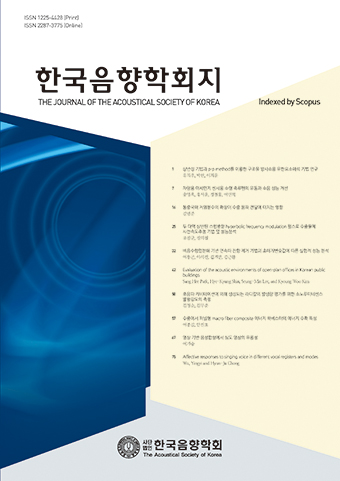 The Journal of the Acoustical Society of Korea